

Asking which developer offers transparent pricing apartments is one of the most useful questions a Kochi buyer can raise before booking, yet it is rarely asked directly. This article gives a practical framework for comparing developers on pricing transparency rather than relying on marketing language alone.
Key Takeaways
- A transparent pricing residential developer will provide a written, itemised breakdown without hesitation.
- All-inclusive pricing is one of the clearest signals of a developer’s pricing transparency.
- A builder’s willingness to answer pricing questions in writing is itself a useful screening test.
Start With a Direct Question
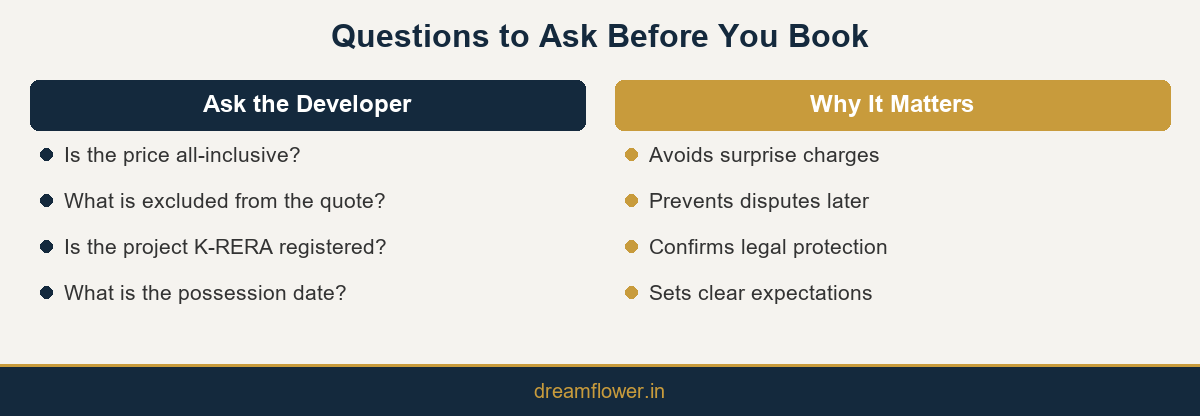
During any site visit, ask the developer whether the quoted price includes car parking, GST, and electricity connection charges, and request the answer in writing. A developer confident in its pricing will provide this without resistance, while evasiveness on this specific question is itself informative.
It helps to ask this question early in the conversation, before a sales executive has invested significant time walking through a specific unit’s layout and amenities. Asking it upfront keeps the framing of the conversation focused on facts rather than on the emotional appeal of the unit itself, which tends to surface more direct, less rehearsed answers.
If the answer is vague or deferred to a later stage of the conversation, treat that as a signal worth following up on directly, rather than assuming the full picture will naturally emerge later. Pricing details that are easy to state clearly at the first question tend to remain the same later on, while those that require repeated follow up are more likely to shift.
Compare Written Breakdowns, Not Headline Prices
Two projects listed at similar headline prices can differ substantially once parking, GST, and utility charges are added. Requesting a written price breakdown from each shortlisted developer and comparing the final, all-in figures is a more reliable comparison method than comparing advertised starting prices.
A simple way to structure this comparison is a single spreadsheet row per developer, with columns for base price, parking, GST, electricity connection, estimated registration, and a calculated total. Filling this in from each developer’s written response, rather than from memory of a verbal conversation, keeps the comparison accurate even weeks after the original site visits.
This structured comparison also becomes useful documentation if a dispute arises later, since it captures exactly what each developer stated in writing at a specific point in time, before any booking amount was paid.
Check the K-RERA Filing
K-RERA registered projects are required to disclose pricing terms as part of their regulatory filing. Cross-referencing a developer’s verbal or brochure pricing against this public filing adds an independent verification step beyond the sales conversation.
This check is particularly valuable because it does not depend on the developer’s continued cooperation. Once a filing is public, a buyer can return to it at any point, independent of whether a sales executive is available or willing to answer further questions, which makes it a more durable source of truth than any single conversation.
Consider the Developer’s Track Record
A developer known for on-time possession record and transparent pricing practices tend to be the same organisations, since both reflect an underlying discipline around clear buyer communication. Reviewing a builder’s history on one dimension often reveals its likely behaviour on the other.
This connection exists because both pricing transparency and delivery reliability stem from the same underlying operational discipline: a developer that plans construction schedules carefully and communicates them clearly tends to apply the same rigour to how it calculates and discloses costs. Conversely, a developer with a history of shifting timelines often shows similar inconsistency in how pricing is communicated across different stages of a sale.
Put the Comparison in Writing Before You Decide
Once the direct question, the written breakdown, the K-RERA filing, and the track record check are complete for each shortlisted developer, put the results side by side in a single document before making a final decision. This avoids relying on impressions formed during separate site visits spread across different days or weeks, which are easy to misremember once several projects start to blend together.
This final step converts four separate checks into one clear picture, and it is often at this stage that the difference between a genuinely transparent developer and one that simply presents well during a site visit becomes obvious.
Why This Framework Works Regardless of Which Developer You Choose
This four-part framework, a direct question, a written breakdown, a K-RERA cross-check, and a track record review, does not depend on already having a preferred developer in mind. It is designed to work as a neutral evaluation tool across any shortlist, which is precisely what makes it more reliable than judging developers primarily on how persuasive their sales presentation feels.
Applying the same framework consistently across every developer being considered, rather than asking different questions of different builders, is what makes the resulting comparison fair and genuinely useful, rather than simply confirming whichever impression a buyer already leaned toward before starting the process.
It is worth revisiting this framework even after narrowing down to a final choice, since a second pass through the same four checks, direct question, written breakdown, K-RERA cross-check, and track record review, right before signing an agreement can catch a detail that was missed during the initial comparison across several shortlisted projects.
Common Mistakes When Comparing Developer Pricing
One common mistake is comparing two projects at different stages of construction as though their pricing were directly comparable, without accounting for the fact that an under construction project further from completion often carries a different risk profile than a nearly finished one, even at a similar quoted price.
Another common mistake is treating a verbal assurance from a friend or relative who purchased from the same developer years earlier as equivalent to current, project specific pricing information. Pricing structures, inclusions, and even a developer’s transparency practices can change from one project to the next, which is why each new comparison should be conducted fresh rather than relying on an older reference point.
A third mistake is stopping the comparison once a single developer’s numbers look favourable, without completing the same four checks for at least one alternative. A single data point, even a good one, does not tell a buyer whether the pricing is genuinely competitive or simply the only option they seriously evaluated.
A fourth, subtler mistake is allowing a developer’s overall reputation to substitute for checking the pricing of a specific current project. Even a well-regarded developer’s pricing practices can vary slightly from one project to the next depending on location, project scale, and market conditions at the time of launch, which is why the same verification steps are worth repeating for every individual project, not just once per developer.
A fifth mistake, common among buyers working through a broker, is treating the broker’s summary of pricing as equivalent to the developer’s own written breakdown. A broker’s summary is a useful starting point, but it is still worth requesting written confirmation directly from the developer before finalising any comparison, since second-hand summaries can occasionally omit a detail that only becomes clear in the original document.
Avoiding these five mistakes does not require any special expertise, only the discipline to apply the same written, itemised comparison consistently across every project under consideration, rather than allowing convenience or a persuasive conversation to shortcut the process on any single one.
Conclusion
Identifying which developer offers transparent pricing apartments comes down to a few concrete checks: a written breakdown, a K-RERA verified filing, and a track record of matching promises to delivery. Request a written price quote from Dream Flower to see this transparency in practice before you book.
Frequently Asked Questions
How do I know if a developer’s pricing is transparent?
Ask for a written, itemised price breakdown covering parking, GST, and electricity charges, and compare the developer’s willingness to provide this without hesitation.
Are all Kochi developers required to disclose full pricing?
K-RERA registered projects must disclose pricing terms as part of their regulatory filing, giving buyers an independent reference beyond sales conversations.
What is all-inclusive pricing?
It means the quoted price already includes charges such as car parking, GST, and electricity connection, leaving only registration as a separate cost.
Why do headline prices differ from final costs?
Some developers quote a lower base price and add parking, taxes, or utility charges later, which inflates the final cost beyond the advertised figure.
Can I compare pricing transparency across different builders?
Yes, requesting a written breakdown from each shortlisted developer and comparing the final all-in totals is the most reliable comparison method.
Does Dream Flower’s track record reflect its pricing practices?
Dream Flower’s 22 year, 66 project history of on-time delivery aligns with its all-inclusive pricing approach, reflecting a consistent focus on buyer transparency.
Should pricing transparency affect my choice of developer?
Yes, since unclear pricing is one of the most common sources of post-purchase disputes in apartment purchases.
What if a developer refuses to provide pricing in writing?
This is generally a signal to proceed cautiously, since a transparent developer has no reason to avoid confirming pricing terms in writing.
Where can I request a price quote from Dream Flower?
Dream Flower’s project listing page and sales team can provide a written price breakdown for any current project.
Does transparent pricing cost more overall?
Not necessarily. Transparent pricing simply ensures the disclosed figure matches the final cost, rather than being inherently higher or lower than non-transparent alternatives.