

Most Kochi apartment buyers need to apply for home loan assistance to complete their purchase, and the process is significantly smoother when the underlying project is K-RERA registered. This article walks through how to request a home loan quote and what banks typically look for before approving a loan against a specific project.
Key Takeaways
- Banks generally prefer lending against K-RERA registered projects due to verified land title and approvals.
- Buyers should request a home loan quote from multiple lenders before committing to one.
- Loan disbursement for under-construction projects is typically linked to construction milestones.
Why K-RERA Registration Simplifies Loan Approval
When a project is K-RERA approved, the land title, statutory approvals, and project details are already verified and part of the public record, which reduces the due diligence burden on a lending bank and often speeds up the loan approval process for buyers.
Banks maintain their own internal lists of projects they are willing to lend against, built up through their own legal and technical verification process. A K-RERA registered project gives the bank’s legal team a documented starting point, land title, sanctioned plan, and disclosed timeline, rather than requiring the bank to independently establish these facts from scratch, which can otherwise add weeks to the approval timeline.
This does not mean every bank automatically approves every K-RERA registered project without further checks, since banks still conduct their own valuation and legal review. It does mean the starting point for that review is considerably stronger, which tends to translate into a faster and less document-heavy process for the buyer compared with financing an unregistered project.
How This Affects Your Loan Eligibility Calculation
Loan eligibility is generally calculated against the declared value of the property, which makes it important to use the complete, all-inclusive price rather than a base figure when approaching a bank for an estimate. A K-RERA filing’s disclosed pricing terms give a bank a consistent reference figure, reducing the chance of a mismatch between what a buyer expects and what the bank is willing to finance.
Buyers should also be aware that a bank’s technical valuation of a project can occasionally differ from the developer’s quoted price, particularly for under-construction projects still some distance from completion. Where a K-RERA filing exists, this valuation gap tends to be smaller, since the bank has more disclosed information to work from rather than relying primarily on the developer’s own figures.
Steps to Apply for Home Loan Assistance
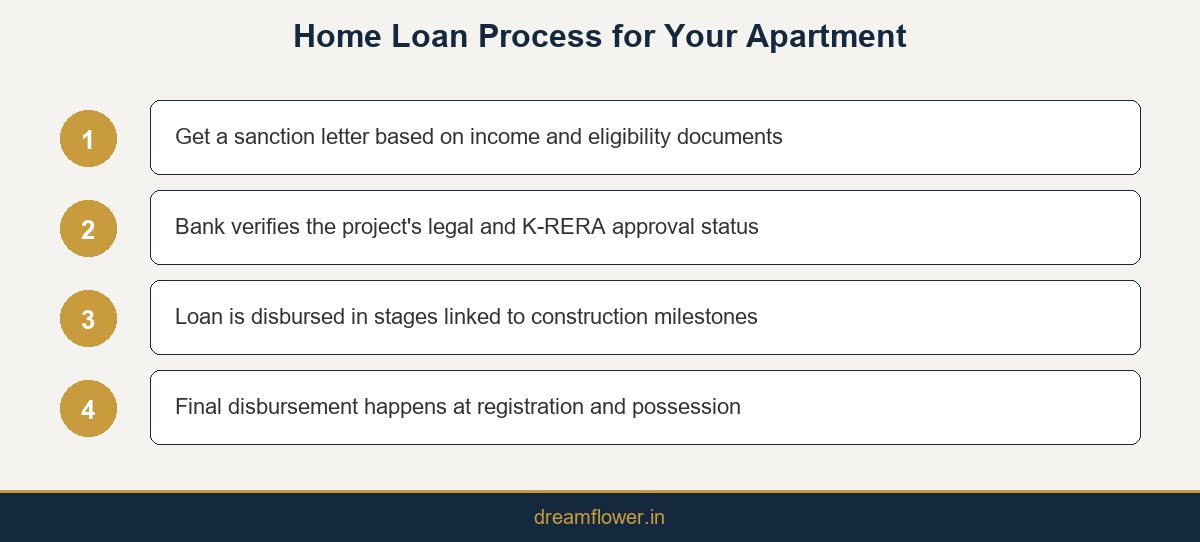
The process typically starts with an in-principle sanction based on income and eligibility documents, followed by the bank’s technical and legal verification of the specific project. For background on lending norms, the Reserve Bank of India publishes consumer facing guidance on housing finance that is useful to review beforehand.
Once in-principle sanction is granted, the bank’s legal team reviews the project’s title and approval documents, which is the stage where K-RERA registration most directly speeds up the process, since much of this documentation is already consolidated in one public filing rather than needing to be separately sourced and verified.
How to Request and Compare Loan Quotes
Buyers should request a home loan quote from at least two or three lenders, comparing not just the interest rate but also processing fees and prepayment terms, since these can meaningfully affect the total cost of the loan over its tenure.
It is worth requesting each quote for the same, specific K-RERA registered project rather than a generic eligibility estimate, since a lender’s willingness to finance a particular project, and the terms offered, can vary once the project’s specific registration and documentation are reviewed.
How Disbursement Works for Under-Construction Projects
For ongoing projects, loan disbursement is usually released in stages tied to construction milestones rather than as a single lump sum, with the final portion disbursed at possession and registration.
A K-RERA registered project’s disclosed construction timeline gives the bank a clear framework against which to schedule these staged disbursements, since the promised milestones are already part of the public record rather than left to informal agreement between the bank and developer on a project by project basis.
Documents to Keep Ready Before You Apply
Alongside standard income and identity documents, keep the project’s K-RERA registration number, the sanctioned building plan reference, and the written all-inclusive price breakdown ready before approaching a lender. Having these on hand from the outset generally shortens the bank’s verification process, since the legal team is not waiting on the buyer to separately source them mid-application.
It is also worth confirming with the developer, in writing, which specific bank branches or lenders have previously financed purchases in the same project, since a lender already familiar with a specific project’s K-RERA filing and documentation can often process a new application faster than one reviewing the project for the first time.
Buyers should treat this documentation checklist as a one-time setup cost that pays off across the rest of the transaction, since the same set of documents is typically needed again at the registration stage, making it worth organising carefully from the very first loan enquiry rather than reassembling it piecemeal at each subsequent step.
What to Do If a Lender Hesitates on a Project
Occasionally a bank may hesitate to finance a specific project even when it is K-RERA registered, often due to internal exposure limits on a particular developer or locality rather than a concern about the project itself. In this situation, it is reasonable to approach a second or third lender rather than assuming the hesitation reflects a problem with the property.
If multiple lenders raise the same specific concern, however, that pattern is worth investigating directly with the developer before proceeding further, since a consistent signal across several independent lenders is more informative than a single institution’s internal policy.
Balancing Loan Tenure Against Possession Timeline
For under-construction projects, it is worth aligning loan tenure discussions with the project’s disclosed K-RERA possession date rather than treating them as two unrelated decisions. Some lenders offer a pre-EMI period, where only interest is paid until possession, switching to full principal and interest repayment afterward, and understanding this structure in advance helps avoid surprises in monthly obligations right around the time moving costs are also being incurred.
Buyers should ask each lender directly how their specific loan product handles this transition period, since terms can vary meaningfully between banks even when headline interest rates look similar, and this detail is easy to overlook when comparing quotes primarily on rate alone.
Why This Matters More for NRI and Remote Buyers
NRI buyers financing a purchase from abroad often work with specialised NRI home loan products that carry their own documentation requirements, including income proof from an overseas employer and specific repatriation rules for repayment. A K-RERA registered project simplifies the property side of this process, but the loan documentation itself still needs to be handled carefully given the additional cross-border requirements involved.
Coordinating a home loan application remotely also benefits from having a local point of contact, whether a family member or the developer’s own team, who can handle physical document submission and bank branch visits on the buyer’s behalf. Confirming this support is available before applying can meaningfully shorten what would otherwise be a slower, more logistically difficult process from overseas.
As with domestic buyers, the underlying principle for NRI applicants stays the same: a K-RERA registered project reduces the property side of the bank’s due diligence, but the loan process itself still rewards buyers who prepare documentation early and confirm requirements directly with the lender rather than assuming a standard domestic process applies unchanged.
Conclusion
Financing a K-RERA approved apartment is generally more straightforward than financing an unregistered project, since much of the bank’s due diligence is already satisfied through registration. Contact Dream Flower to apply for home loan assistance and request a quote for any current project.
Frequently Asked Questions
Why do banks prefer K-RERA registered projects for home loans?
Registration verifies land title and statutory approvals in advance, which reduces the bank’s due diligence burden and often speeds up loan approval.
How do I request a home loan quote?
Contact the developer’s sales team or a lender directly with the project details to receive a quote covering interest rate, processing fees, and terms.
Is loan disbursement different for under-construction apartments?
Yes, disbursement is typically released in stages linked to construction milestones, with the final portion paid at possession and registration.
Should I compare quotes from multiple banks?
Yes, comparing interest rates, processing fees, and prepayment terms across two or three lenders can meaningfully affect the total loan cost.
Does all-inclusive pricing affect my loan eligibility calculation?
Yes, since the all-inclusive price reflects the true total cost, it gives a more accurate basis for calculating loan eligibility than a base price that excludes additional charges.
What documents are needed to apply for home loan assistance?
Typically income proof, identity and address documents, and the project’s approval and registration details are required for the bank’s verification process.
Can I get home loan assistance for a ready-to-move apartment?
Yes, ready-to-move apartments can also be financed through a home loan, generally with the full amount disbursed closer to registration rather than in construction-linked stages.
How does K-RERA status affect my loan interest rate?
K-RERA status itself does not set the interest rate, but a verified, lower-risk project can make lenders more willing to offer competitive terms.
Where can I see current project pricing before applying for a loan?
Dream Flower’s project listing page shows current price ranges to help estimate loan eligibility before formally applying.
Does Dream Flower assist directly with the loan application process?
Dream Flower’s sales team can guide buyers through the home loan assistance process and help connect them with relevant documentation for lenders.