

Every nri guide to buying apartments in kochi eventually reaches the same question. How do you trust a builder you cannot visit in person. Bank transfers, notarized paperwork, and remote documentation are solvable problems with the right process. Trusting the builder itself is harder to outsource. This guide focuses specifically on verification rather than paperwork. For the regulatory step by step process, including FEMA rules and account setup, see Dream Flower’s dedicated NRI documentation guide. Here, the focus stays on confirming a builder’s claims before any money changes hands.
Key Takeaways
- K RERA registration is the single most checkable fact about any project, and confirming it takes only minutes.
- A builder’s delivery history matters more than current marketing, since only history proves a consistent pattern.
- Configuration choice affects how easily a unit rents or resells later, which matters most when you are not living in it yourself.
Why Verification Matters More When You Cannot Visit
A resident buyer can resolve most doubts with a single site visit. Structural progress, neighbourhood noise, finish quality, and even the sales office atmosphere all become obvious in person. That option is harder to exercise from Dubai, Riyadh, Doha, or Muscat, where a return trip specifically to inspect a construction site is rarely practical on short notice.
This is why an nri guide to buying apartments in kochi needs a different structure than a typical resident buying guide. Instead of walking you through a single visit, it walks you through a set of checks that substitute for that visit. Each of the sections below covers one of those checks, in the order most buyers find useful to work through.
It helps to think of these checks as a filter rather than a formality. Most builders active in a growing market like Kochi are legitimate, but the small number that are not tend to rely specifically on buyers who skip verification because they are far away and pressed for time. Working through this list in order removes that advantage before it can be used against you.
The Cost of Skipping This Step
The most common regret reported by remote buyers is not fraud, which is rare, but mismatched expectations. A unit that looked complete in photos but was months behind schedule, or a configuration that turned out harder to rent than expected, both trace back to a verification step that was skipped or rushed at the start.
Start With K RERA Registration, Not Marketing Claims
Marketing copy can say almost anything. A regulatory filing cannot. Before you evaluate amenities, floor plans, or even price, confirm that the specific project you are considering carries an active K RERA registration number, and that the number matches the project name exactly, not just the builder’s name.
This single step does more work than any other item on this list, because it converts a claim you would otherwise have to take on trust into a fact you can check independently, from anywhere, at any hour.
What K RERA Registration Actually Discloses
A registered project is required to disclose its approved building plan, its expected completion timeline, and the land title under which it is being developed. These three facts alone answer most of the questions a site visit would otherwise answer for you.
Registration also means the project is subject to ongoing regulatory oversight rather than a one time approval. Builders are expected to keep certain disclosures current as construction proceeds, which gives a remote buyer a way to track progress against an official record rather than relying only on the builder’s own updates.
How to Cross-Check It Yourself
Ask the builder for the registration number directly, then verify it independently rather than taking a screenshot at face value. If a project cannot produce a clear, verifiable registration number on request, treat that as a reason to slow down, not a detail to follow up on later.
It is worth doing this check before you engage emotionally with a specific unit or floor plan. Buyers who fall in love with a layout first sometimes talk themselves out of following up on a registration gap. Doing the check first removes that bias entirely.
Look at Delivery History, Not Just Current Listings
Any builder can describe a single project attractively. Delivery history is harder to fabricate, because it accumulates over years and is visible to anyone who asks previous buyers directly. Ask specifically how many projects a builder has completed, and whether those projects were handed over on the timeline originally promised, not simply completed eventually.
As a benchmark for what a strong answer looks like, Dream Flower points to 22 years of operation, 66 projects delivered on time, and roughly 1,089 customers served across its portfolio. Whichever builder you are evaluating, ask for comparable numbers and be specific about wanting the on time figure, not just the total project count.
Why On Time Delivery Matters More for NRI Buyers
A delayed handover is an inconvenience for a resident buyer, who can usually absorb a few months of delay by adjusting their own moving plans. For an NRI buyer relying on the unit for rental income from a specific date, or planning a trip home around possession, a delay carries a real financial and logistical cost that is harder to absorb from a distance.
Set Up Remote Monitoring Before You Book
Once you have confirmed registration and history, the next practical question is how you will track progress after booking. Ask the builder directly what construction updates they provide, in what format, and how often. A builder confident in its own timeline usually has a standard answer ready, rather than needing to design a special process just for you.
Useful formats include periodic photo updates tied to construction milestones, short video walkthroughs recorded on site, and a named point of contact who can answer specific questions about your unit rather than the project in general. Agree on this cadence before you book, not after, so there is a shared expectation from day one.
It is reasonable to ask for this in writing, even briefly, as part of your booking correspondence. A simple written note confirming how often updates will be sent, and through which channel, prevents the common situation where updates quietly become less frequent once payments have started.
Choose a Configuration That Rents or Resells Easily
Many NRI buyers plan to rent a Kochi apartment out for years before eventually deciding whether to sell, retain, or move into it. That plan works better when the configuration you choose matches actual demand in that specific micro market, not simply the configuration that felt right in the sales brochure.
This is a decision worth making deliberately rather than defaulting to whichever configuration happens to be available first. A slightly longer search for the right unit size is a small cost compared to years of a harder to rent apartment.
Matching Configuration to Tenant Demand
A detailed comparison of how 2 BHK and 3 BHK units perform for a remote landlord, covering tenant pool size, maintenance burden, and ease of finding a manager, is covered separately in our guide on choosing an apartment configuration for remote rental management.
In general, smaller configurations tend to attract a wider and steadier pool of prospective tenants, which shortens the gap between one tenancy ending and the next beginning, a gap that is more costly to manage from overseas than it is locally.
Thinking Beyond the First Buyer
Configuration also affects resale later. A unit that is easy to rent to a wide pool of tenants is usually also easier to resell to a wide pool of future buyers, which reduces how long the unit might sit unsold if your plans change.
Vet Whoever Represents You on the Ground
If you cannot attend registration or every site visit personally, someone will act on your behalf, usually through a Power of Attorney arrangement. The legal mechanics of notarizing and executing that document are covered in the existing documentation guide referenced earlier in this article. What deserves separate attention is who you choose to hold that authority in the first place, and how you keep visibility into what they are doing with it.
This is frequently the most underweighted decision in the entire process. Buyers spend weeks comparing projects and days comparing floor plans, then hand a significant scope of authority to a family member or contact with little more thought than a phone call.
A dedicated set of questions to work through before appointing anyone to this role is covered in our guide on vetting a local representative for NRI buyers, including how to scope the authority you grant and how to agree on a reporting routine in advance.
Decide Early Whether This Is an Investment or a Future Home
Some NRI buyers know from the outset that a Kochi apartment is a pure rental investment. Others expect to move back to India eventually and treat the same purchase as a future residence. The distinction matters, because it changes how you think about location, configuration, and even which building amenities are worth paying for now.
A buyer planning eventual relocation may reasonably prioritize proximity to family, schools, or a particular neighbourhood over the highest rental yield configuration, since the property is ultimately being chosen for a future life stage rather than short term returns alone.
If a permanent return is part of your plan, our guide on what happens to your Kochi apartment when you return to India permanently walks through the practical transition from landlord to resident owner, including how to plan the handover with minimal disruption.
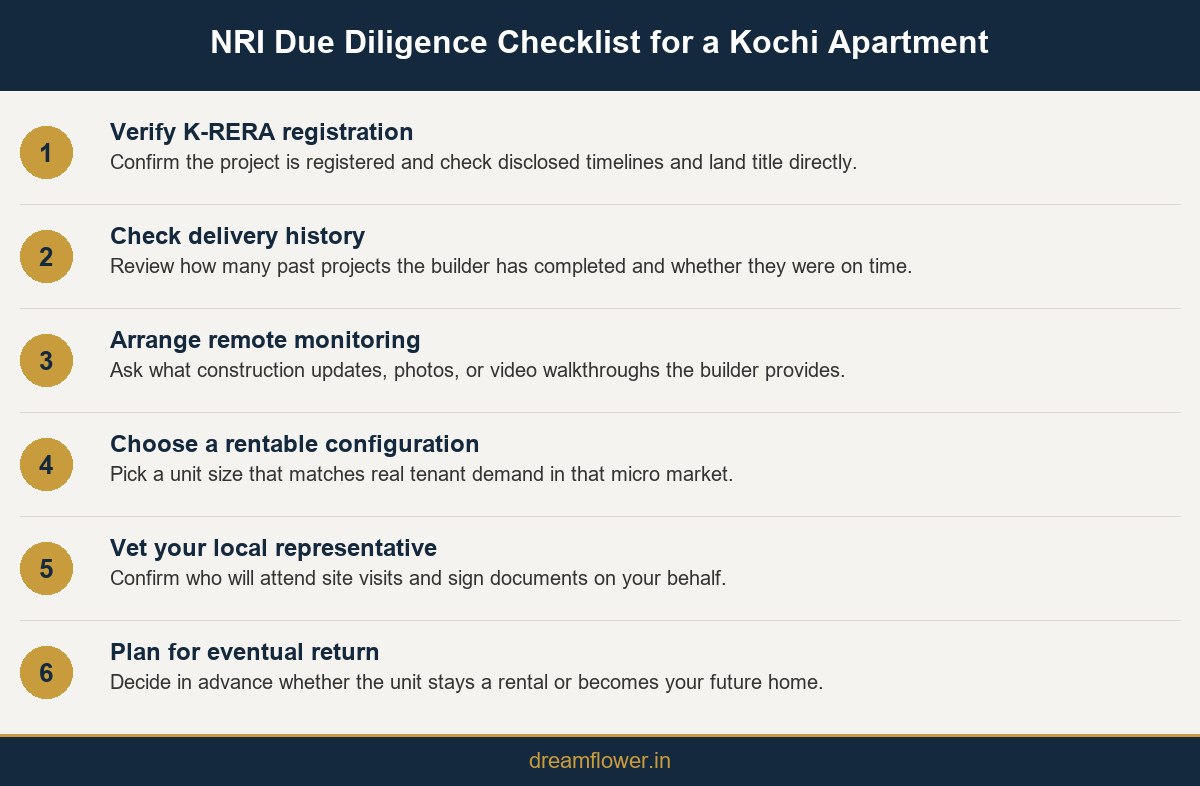
How These Steps Fit Into a Realistic Purchase Timeline
Reading through six or seven verification steps can feel more demanding than it actually is once spread across a realistic timeline. Most remote buyers complete the checks in this guide over two to four weeks, running alongside ordinary shortlisting and price negotiation rather than as a separate delay.
A practical sequence looks like this. In the first week, shortlist two or three projects and confirm K RERA registration for each before spending further time on any of them. In the second week, request delivery history and reviews for whichever projects remain after that first filter, and use that information to narrow the shortlist further. In the third week, agree on a monitoring cadence and begin the conversation about who will represent you locally. By the fourth week, most buyers are ready to make a booking decision with reasonable confidence.
This pacing is not a strict rule, and some buyers move faster once they find a project that clears every check quickly. The point is that verification does not need to feel like an obstacle course. Treated as a short, structured routine, it fits comfortably into the same timeframe most buyers already spend comparing options before deciding.
Common Red Flags That Are Easy to Miss From a Distance
A few warning signs recur often enough among remote NRI purchases that they are worth listing explicitly, separate from the verification steps above. None of these alone proves a problem, but each one is a reasonable trigger to slow down and ask more questions before proceeding.
Reluctance to share a K RERA registration number quickly and directly is the clearest signal. A second is pressure to book within an unusually short window, particularly when that pressure is framed around a discount that expires the same day. Genuine limited time offers exist, but so does artificial urgency designed to discourage the verification steps covered earlier in this guide.
A third signal is vague or shifting answers about handover dates across different conversations, whether with a sales representative on one call and a different representative on the next. Consistency in the answers you receive is itself a form of verification, since it suggests the information is coming from an actual project plan rather than being improvised per conversation.
What a Reasonable Builder Response Looks Like
A builder confident in its own project typically welcomes these questions rather than treating them as an inconvenience. If registration numbers, delivery history, and handover dates are answered consistently and promptly across multiple contacts within the same organisation, that consistency is itself a reassuring sign worth noting.
Understanding Currency and Timing Risk When Paying From Abroad
Beyond verifying the builder, a remote purchase carries a second category of risk that has nothing to do with construction quality at all, which is currency movement between the time a price is quoted and the time each instalment is actually paid. Kochi apartment purchases typically involve staged payments tied to construction milestones, spread over one to three years for an under construction project.
Over that period, exchange rate movement between the Gulf dirham or riyal and the Indian rupee can meaningfully change the effective cost of later instalments compared to the first. This is not something a builder controls or is responsible for, but it is worth factoring into your own budgeting rather than assuming the quoted price in your home currency will stay fixed throughout construction.
A related practical point is payment timing discipline. Missing an instalment deadline, even for reasons entirely outside your control such as a delayed bank transfer, can carry contractual consequences depending on the builder’s payment schedule terms. Building in a short buffer before each due date, rather than initiating a transfer on the deadline itself, avoids this avoidable risk.
Where to Get the Regulatory and Tax Detail You Will Also Need
This guide has deliberately stayed on verification rather than process, because that is the part most generic guides skip. For the parts it deliberately leaves out, including FEMA eligibility, NRE and NRO account setup, home loan mechanics, registration charges, and repatriation rules on sale, see Dream Flower’s documentation and ROI guide directly.
For current lending policy detail, the Reserve Bank of India publishes updated guidance that any chartered accountant or bank relationship manager can walk you through in more depth than a blog post reasonably can. Rules in this area change periodically, so treat any specific figures you read as a starting point for a conversation with a qualified professional, not a final answer.
Used together, the verification steps in this guide and the process detail in the documentation guide cover the two halves of a remote purchase that most buyers need. One tells you whether to trust the builder. The other tells you how to complete the transaction once you do.
Comparing Multiple Builders at Once
Most buyers do not evaluate a single project in isolation. They compare two, three, or sometimes more, often across different builders and different parts of Kochi. Running the same verification steps consistently across every option, rather than doing a thorough check on a favourite and a quick glance at the rest, is what makes the comparison meaningful.
A simple approach is to build a short table for yourself with one row per project and one column per check covered in this guide, registration status, years in operation, projects delivered on time, monitoring format offered, and configuration fit. Filling that table in before comparing prices keeps the decision grounded in verified facts rather than whichever project happens to have the most persuasive sales conversation.
Conclusion
None of the steps in this nri guide to buying apartments in kochi are complicated on their own. Confirming registration, checking delivery history, agreeing on remote monitoring, choosing a sensible configuration, and vetting your local representative are all manageable from anywhere in the world. What matters is doing them in order, before you book, rather than after a payment has already been made. If you would like to discuss a specific project against this checklist, contact Dream Flower’s sales team directly.
Frequently Asked Questions
Is it safe for an NRI to buy an apartment in Kochi without visiting in person?
It can be, provided you verify K RERA registration, delivery history, and set up remote monitoring before booking. These checks substitute for a site visit and reduce the risk of relying on marketing claims alone.
What is the fastest way to check if a Kochi project is genuine?
Ask for the K RERA registration number and confirm it matches the exact project name. A builder unable to produce this quickly is the clearest early warning sign available to a remote buyer.
Should an NRI buyer prioritize price or builder track record?
Track record first. A lower price from an unverified builder carries more risk than a slightly higher price from a builder with a documented history of on time delivery.
How many past projects should a builder have before I trust them?
There is no fixed number, but ask specifically how many were delivered on the originally promised timeline, not just the total count. Consistency matters more than volume.
Can I rely on video calls instead of a Power of Attorney?
Video calls help you monitor progress but do not replace legal authority for registration and document signing. See our guide on vetting a local representative for how to combine both safely.
What documents should I ask for before booking a unit remotely?
At minimum, the K RERA registration certificate, approved building plan, and a written construction and payment schedule. The detailed documentation checklist is covered in Dream Flower’s dedicated NRI guide.
Does Dream Flower offer remote booking for NRI buyers?
Dream Flower can be contacted directly to discuss remote booking support for its current projects. Reach the sales team here to ask about a specific project.
Is a 2 BHK or 3 BHK easier to manage as an NRI landlord?
A 2 BHK generally has a larger tenant pool and simpler upkeep, while a 3 BHK can suit longer term family tenants. A full comparison is covered in our configuration guide for remote rental management.