

Most guides aimed at apartments recommended for long term investment focus on buying and renting, and stop there. Fewer address what happens next, when an NRI owner eventually returns to India permanently and the property shifts from a rental asset into an actual home. This guide covers that practical transition rather than the tax or repatriation mechanics of selling.
Key Takeaways
- Review your rental agreement’s notice period well before your planned return date.
- Residency and account status updates should happen promptly once you are back.
- Deciding early whether to move in or keep renting shapes the whole handover timeline.
A Transition Most Buying Guides Skip
Buying guides for apartment types for rental income typically end at handover or, at most, at the first tenancy. Almost none address the later stage where an owner’s own circumstances change and the property needs to shift roles, from investment to residence.
This gap is understandable, since the timeline varies enormously between owners. Some plan a return within a few years, others after a decade or more, and some never return at all. But for anyone who does plan an eventual move back, having a rough sense of the transition in advance makes the actual process considerably smoother when the time comes.
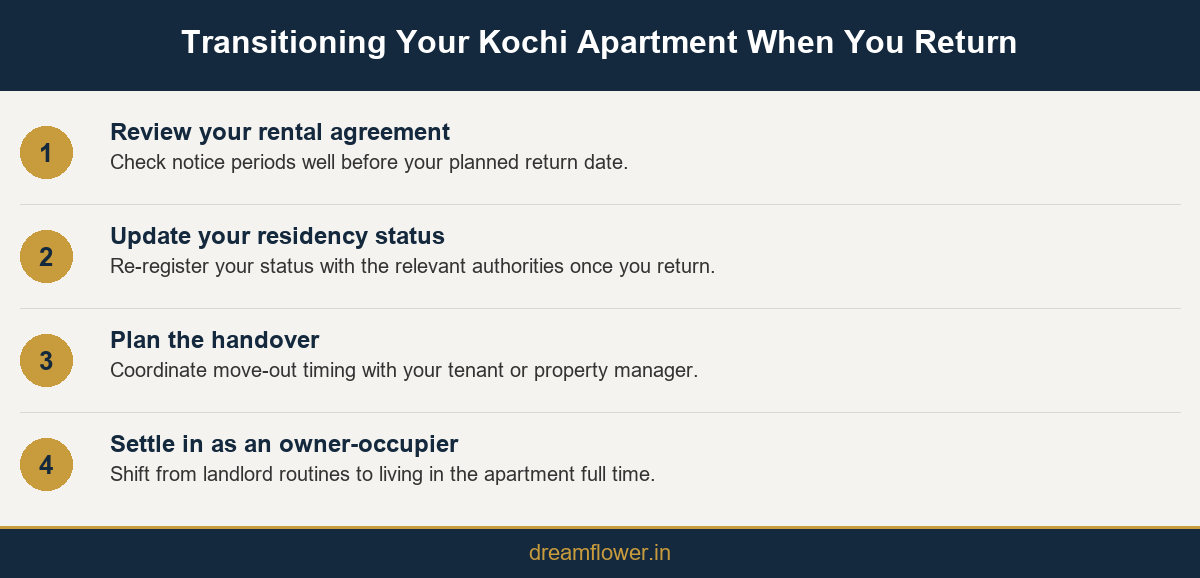
This guide walks through that transition in the order most owners actually experience it, starting with the rental agreement already in place and ending with settling in as an owner occupier.
Reviewing Your Rental Agreement Before You Return
If your apartment is currently tenanted, the practical starting point is your existing rental agreement, specifically its notice period and renewal terms. Most agreements require a fixed notice period before a tenancy can be ended for owner occupation, and starting this process only after you have already returned often creates an avoidable gap.
A reasonable rule of thumb is to review this timeline at least six months before your planned return, even if the actual return date is still uncertain. This gives you room to align the end of the current tenancy with your move rather than either rushing a tenant out or living elsewhere temporarily while the agreement runs its course.
If your return date is genuinely flexible, discuss this openly with your tenant or property manager rather than leaving the timeline ambiguous. A tenant given reasonable notice is far more likely to cooperate smoothly with the transition than one informed at the last moment.
Updating Your Residency and Account Status
Once you have returned and settled your immediate plans, update your residency status with the relevant authorities and financial institutions rather than leaving accounts and records reflecting your previous NRI status indefinitely.
This is largely an administrative step, but one that is easy to postpone since it carries no immediate urgency the way a rental handover does. Addressing it within a reasonable window after your return avoids complications that can otherwise surface later, for instance when applying for local services that check current residency status.
A chartered accountant familiar with the transition from NRI to resident status can confirm exactly which updates apply to your specific situation, since requirements can vary depending on how your finances were structured while abroad.
Planning the Physical Handover
If the apartment is tenant occupied, coordinate the handover date directly with your tenant or property manager well in advance, including a clear plan for any repairs or refresh work needed between the previous tenancy ending and your own move in.
Apartments that have been tenanted for several years often need some degree of refresh, repainting, fixture checks, or deep cleaning, before they feel ready for your own occupation rather than simply meeting the standard expected between one tenant and the next.
Building a short buffer period into your plan, rather than assuming you can move in the same day a tenancy ends, reduces stress on both sides of the handover and gives you room to address anything unexpected.
Settling In as an Owner Occupier
Moving from landlord to resident changes your relationship with the building itself. Association fees, maintenance requests, and community matters that were previously handled by a property manager on your behalf now become things you engage with directly.
This is generally a welcome change for owners who have been managing the property remotely for years, since it replaces indirect oversight with direct, first hand involvement. It is worth introducing yourself to building management and neighbours early, both as a practical matter and as a way of settling into the community more quickly.
It also gives you a chance to reassess anything a property manager may have handled differently than you would have preferred while you were abroad. Small adjustments to how maintenance requests are logged or how association meetings are attended are easier to make once you are the one directly involved rather than relying on secondhand updates.
If You Are Not Ready to Move In Yet
Returning to India does not always mean moving into this specific apartment immediately. Some owners return to a different city for work or family reasons and continue renting the Kochi property out for a further period.
In that case, the considerations from this guide still apply, just on a delayed timeline. It is still worth reviewing your rental agreement periodically and keeping your own plans roughly aligned with your tenancy terms, so that whenever the eventual transition does happen, it follows the same smooth process rather than an abrupt one.
Some owners in this position choose to formalise property management more thoroughly for this extended period, treating it as an ongoing arrangement rather than a temporary one, which can make sense if the delay before an eventual move in stretches well beyond the original expectation.
Where to Get Tax and Repatriation Detail If You Choose to Sell Instead
Not every returning owner chooses to move in. Some decide to sell instead, particularly if their life has settled in a different city. Selling involves a different set of considerations, including capital gains tax and repatriation rules, which are covered in detail in Dream Flower’s dedicated NRI documentation and ROI guide rather than repeated here.
The distinction is worth making explicitly. This guide covers the transition to living in the property yourself. The documentation guide covers the transition to selling it. Which path applies to you depends entirely on your own plans once you are back in India.
It is worth deciding between these two paths as early as possible, since preparing an apartment for your own occupation and preparing it for sale involve different priorities, from the kind of refresh work worth doing to how you time the end of an existing tenancy.
Conclusion
For an owner among apartments recommended for long term investment, returning to India permanently is the point where the property finally becomes what many buyers originally intended it to be, a home rather than only an asset. Reviewing your rental agreement early, updating your residency status promptly, and planning the physical handover carefully make that transition considerably smoother. For guidance on the sale path instead, see Dream Flower’s dedicated NRI documentation guide, or contact Dream Flower directly with questions about a specific project.
Frequently Asked Questions
How much notice should I give my tenant before moving back into my own apartment?
Check your rental agreement’s specific notice period and plan to start the conversation at least six months before your intended return where possible.
Do I need to update anything after returning to India from NRI status?
Yes, update your residency status with relevant financial institutions and authorities. A chartered accountant can confirm which specific updates apply to your situation.
Should I renovate before moving into a previously rented apartment?
Many owners do some refresh work, repainting or fixture checks, between a tenancy ending and their own move in. Build a short buffer period into your plan for this.
What if my return date to India is still uncertain?
Discuss this openly with your tenant or property manager rather than leaving the timeline ambiguous. Flexibility works better when communicated clearly in advance.
Can I keep renting out my Kochi apartment after returning to India?
Yes, some owners return to a different city and continue renting the property for a further period before eventually moving in or selling.
What if I decide to sell instead of moving in?
Selling involves different considerations, including capital gains tax and repatriation rules, covered in Dream Flower’s dedicated NRI documentation and ROI guide.
Who should I talk to about association fees once I become an owner occupier?
Introduce yourself to building management directly once you move in, since these responsibilities shift from your property manager to you personally.