
Choosing between recommended flats for rental yield investors often comes down to a single decision, 2 BHK or 3 BHK. Locality yield percentages get most of the attention, but for an owner managing a property from abroad, practicality matters just as much as the headline number. This guide compares the two configurations specifically from a remote landlord’s point of view.
Key Takeaways
- A 2 BHK typically draws from a wider tenant pool, which shortens vacancy periods.
- A 3 BHK can attract longer term family tenants but takes longer to place between tenancies.
- Maintenance coordination from abroad is generally simpler for smaller apartment types for rental income.
Why Configuration Matters More Than Locality Rankings for Remote Landlords
Locality level yield rankings answer a useful but narrow question, which areas of Kochi currently produce the strongest average returns. They say much less about how easy a specific unit will be to manage once you are the one signing tenancy agreements from thousands of kilometres away.
Two identical yield percentages can come with very different management experiences depending on configuration. A unit that rents quickly and needs little coordination is worth more to a remote owner than one with a marginally higher yield that sits vacant for an extra month between tenants or requires frequent decisions only an owner on the ground can make comfortably.
This guide sets locality aside deliberately and focuses only on the configuration decision, since that is the part most generic investment guides skip in favour of yield tables.
Tenant Demand Pool by Configuration
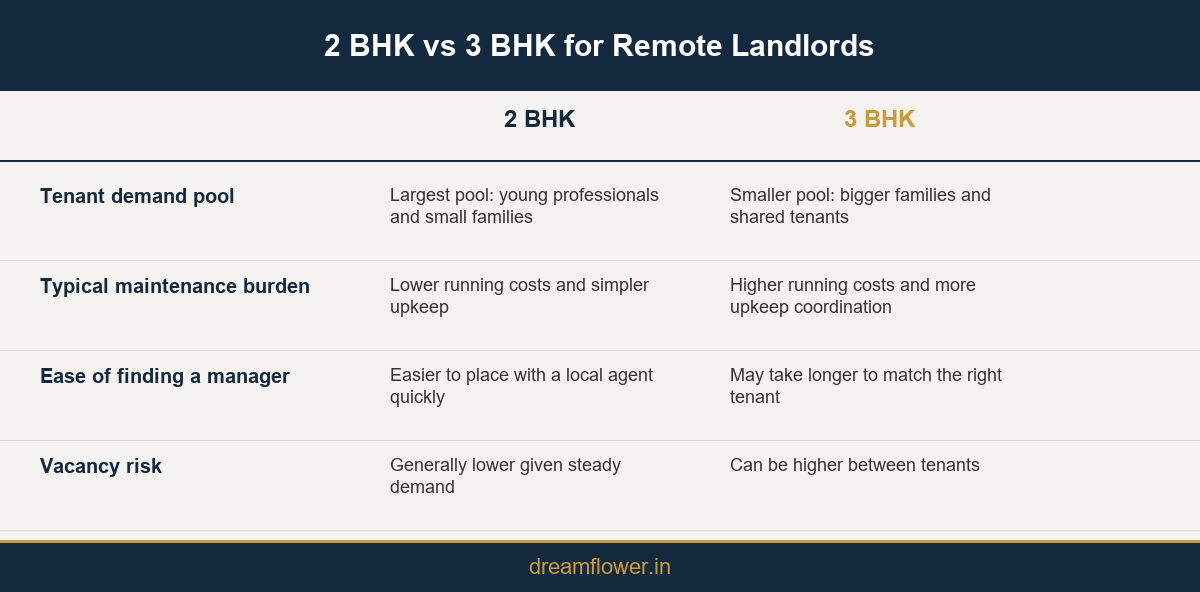
In most Kochi micro markets, 2 BHK units draw interest from a broader range of tenants, including young professionals, couples, and small families, simply because the rent falls within a wider range of household budgets.
3 BHK units draw from a narrower pool, typically larger families or shared arrangements among working professionals, which can mean a longer search each time a tenancy ends, even in a generally strong rental market.
Neither pattern is a rule without exceptions, and specific buildings or micro markets can behave differently. The broader point is that pool size, not just headline rent, affects how quickly a vacancy gets filled, which matters more to an owner who cannot personally show the unit to prospective tenants.
Maintenance Burden You Cannot Inspect Yourself
A larger unit generally means more fixtures, more surface area, and more maintenance requests over time, from plumbing to appliances to general wear. Each of those requests, for a remote owner, becomes a coordination task handled through a property manager, a local representative, or the builder’s after sales team rather than something you can assess with your own eyes.
A smaller, simpler configuration reduces the frequency of these requests, which reduces how often you need to make a decision, approve an expense, or follow up on a repair from a different time zone.
This does not mean a 3 BHK is unmanageable remotely. It means the practical coordination overhead is generally higher, and worth weighing against whatever additional rent or resale value the larger configuration offers.
Vacancy Risk and How Configuration Affects It
Every period a unit sits vacant between tenants is a period of lost rental income, and for a remote owner it is also a period where you are relying entirely on someone else to manage showings, applications, and paperwork on your behalf.
Because 2 BHK units generally draw a wider tenant pool, they tend to be re let faster on average, shortening this vacancy window. A 3 BHK may command a higher rent per tenancy but can offset some of that advantage with a longer gap between tenants.
When comparing two configurations, it is worth asking a local property manager or the builder’s after sales team directly how long similar units in the same building typically stay vacant between tenancies, rather than relying on general assumptions.
Resale Flexibility Follows the Same Pattern as Rental Demand
Configuration choice does not only affect how easily a unit rents. It also affects how easily it resells later, whether you sell after a few years or after decades of ownership.
A configuration with strong rental demand generally also has strong resale demand, since the same underlying factors, budget fit and household size, apply to buyers as much as to tenants. A unit that sat comfortably rented for years is usually also a unit that finds a buyer without an extended search.
This connection is worth keeping in mind even if resale feels distant when you are first buying. Plans change, and a configuration that stays broadly appealing to both tenants and future buyers gives you more flexibility if your own circumstances shift.
Furnishing and Handover Condition Also Affect Ease of Renting
Configuration is not the only factor that affects how quickly a unit rents. Whether a unit is handed over semi furnished or bare shell changes how much work is needed before it is rental ready, which matters more for a remote owner who cannot personally oversee finishing work after handover.
A semi furnished 2 BHK is often faster to prepare for a first tenant than a bare shell 3 BHK, simply because less remains to be arranged from a distance. If minimising post handover coordination is a priority, factor handover condition into the decision alongside configuration itself.
This is worth confirming directly with the builder before booking, since handover condition can vary between projects and even between unit types within the same project.
Matching Configuration to Your Own Plans
If your primary goal is steady rental income with minimal remote coordination, a 2 BHK generally aligns better with that goal given its wider tenant pool and simpler upkeep.
If you expect to eventually use the apartment yourself, whether for extended visits or an eventual permanent return, a 3 BHK may make more sense despite the added management overhead, since it better suits your own future use rather than pure rental efficiency.
There is no universally correct answer. The right configuration depends on which of these two goals matters more to you, and being honest about that priority upfront avoids a mismatch later.
It also helps to revisit this decision periodically rather than treating it as fixed at the time of purchase. Circumstances change, and an owner who originally bought purely for rental income may later decide to use the unit personally, or the reverse. Being clear about your current priority does not mean it cannot shift over time.
A Practical Way to Decide
A simple exercise is to list your priorities in order, rental ease, future personal use, budget, and resale flexibility, then check which configuration best satisfies the top two rather than trying to optimise for all four equally.
For current examples of both configurations, Proxima in Kakkanad and Sacro Esquina in Edappally both offer 2 and 3 BHK options within the same project, which makes it possible to compare pricing and layout for both configurations side by side before deciding.
Comparing within a single project also controls for factors like building amenities and location, leaving configuration as close to the only variable as possible. That makes the comparison more meaningful than comparing a 2 BHK in one project against a 3 BHK in an entirely different one.
Conclusion
Among recommended flats for rental yield investors, the right configuration depends less on a single yield percentage and more on how much remote coordination you are prepared to take on. A 2 BHK generally offers simpler management and a wider tenant pool, while a 3 BHK suits buyers planning eventual personal use. For a broader verification checklist before choosing any specific project, see our main guide on buying an apartment in Kochi as an NRI.
Frequently Asked Questions
Is a 2 BHK or 3 BHK better for rental income in Kochi?
A 2 BHK generally offers a wider tenant pool and simpler maintenance, while a 3 BHK can command higher rent but with a narrower pool of prospective tenants.
Does a larger apartment always earn more rental income?
Not necessarily. Higher rent per tenancy can be offset by longer vacancy periods between tenants, particularly for owners managing the property remotely.
How does remote management affect the configuration decision?
Smaller configurations generally require less coordination for maintenance and tenant turnover, which matters more when you cannot inspect issues yourself.
Should I choose a configuration based on locality yield data alone?
Locality yield data is useful context but should be combined with configuration specific factors like tenant demand and maintenance burden for a fuller picture.
Can I compare 2 BHK and 3 BHK options within the same project?
Yes. Projects like Proxima and Sacro Esquina offer both configurations, making direct comparison easier.
What if I plan to use the apartment myself eventually?
In that case, a 3 BHK may suit your long term plans better than a 2 BHK, even with a higher management overhead in the meantime.
How do I estimate vacancy risk before buying?
Ask a local property manager or the builder’s after sales team how long similar units in the same building typically stay vacant between tenancies.