

Finding a trusted apartment developer for remote buyers starts with a simple shift in approach. Instead of judging a builder by how convincing a single sales conversation feels, judge them by a small set of facts that can be checked independently from anywhere. This guide walks through exactly what to check and how to check it without needing to be in Kochi yourself.
Key Takeaways
- K RERA registration status is the fastest independent check available to a remote buyer.
- Delivery timeline history matters more than total project count when judging reliability.
- Independent reviews are more useful than testimonials sourced from the builder’s own marketing.
Why Track Record Beats a Single Project’s Marketing
A single project can be photographed, described, and marketed attractively regardless of the builder’s actual reliability. Track record is different, because it accumulates across multiple projects over years and cannot be assembled quickly for a single sales campaign.
For apartment options for nri investors specifically, this distinction matters more than it does for a resident buyer, since a remote buyer usually cannot fall back on word of mouth from neighbours or a personal visit to a completed project nearby.
Marketing material is designed to be persuasive, which is not the same as being complete. A brochure will highlight the amenities that photograph well and the completion date that sounds closest, while track record, drawn from what actually happened on previous projects, gives a fuller and more balanced picture.
This is particularly relevant when a project is still under construction, since there is little else to evaluate beyond renderings and promises at that stage. Track record becomes the closest available substitute for the finished product a resident buyer might otherwise be able to see for themselves nearby.
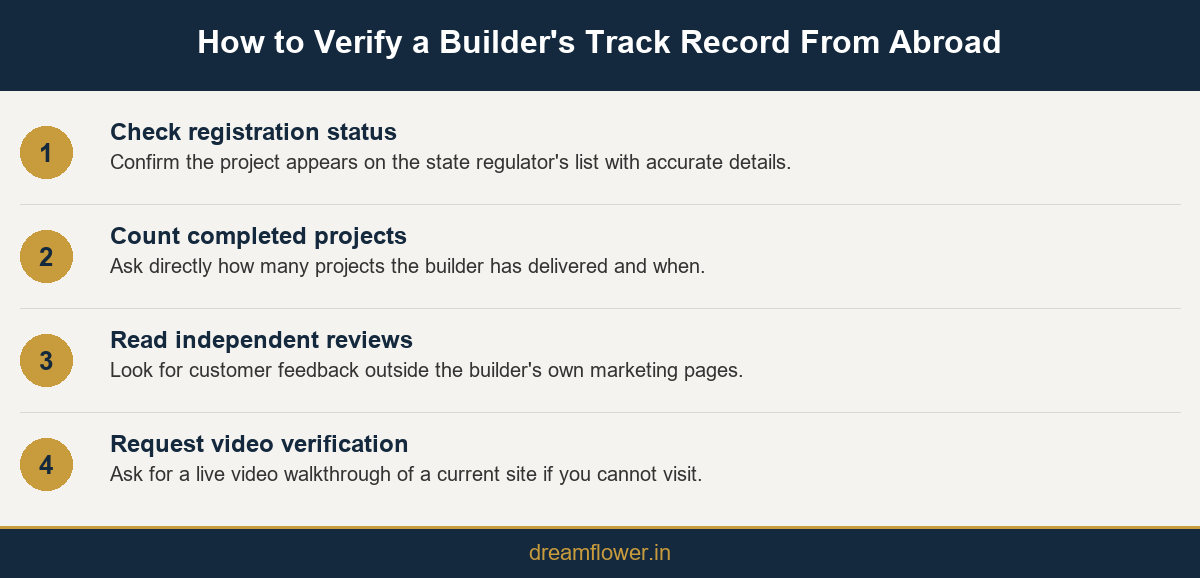
Start With the K RERA Registration Number
Every legitimate project should carry an active registration number that can be checked independently of anything the builder tells you directly.
Ask for this number early in the conversation, before discussing price or floor plans, and treat hesitation or delay in providing it as a meaningful signal on its own.
This single check takes only a few minutes but does more to protect a remote buyer than almost any other step in the entire process, since it converts an unverifiable claim into a fact you can confirm yourself.
Ask for the Delivery Timeline, Not Just the Project Count
A recommended developer for nri property investment should be able to state clearly how many projects it has delivered and whether each was completed on the promised timeline.
A builder that answers this question with specific dates and project names is demonstrating a different level of transparency than one that offers only a general total.
It is reasonable to ask this question more than once across different conversations, whether with a sales representative on a call and again by email. Consistent answers across those separate conversations are themselves a form of confirmation.
If a builder cites external recognition or awards, treat that as a secondary detail rather than a substitute for delivery data. Awards can reflect design or marketing quality without saying anything specific about whether past handover dates were met.
Reading Between the Lines of Customer Reviews
Reviews hosted on the builder’s own website are useful context but should be weighed alongside independent sources, since they are naturally curated to be favourable.
Look specifically for reviews that mention handover timing and post handover support, since these two details are the ones remote buyers most often wish they had checked earlier.
A single negative review is rarely disqualifying on its own, since every builder accumulates some dissatisfied customers over enough projects. A pattern of similar complaints repeated across several independent reviews is the more meaningful signal to watch for.
Where possible, ask the builder directly for contact details of a recent buyer willing to answer a short set of questions. A builder confident in its own delivery record is usually willing to facilitate this, even briefly, which is itself a useful signal beyond whatever the buyer actually says.
What a Strong Track Record Looks Like in Practice
As one example of what this looks like when stated clearly, Dream Flower points to 22 years of operation, 66 projects delivered on time, and roughly 1,089 customers served, figures that are specific enough to be checked rather than simply taken on faith.
Whichever builder you are evaluating, ask for a comparable statement and treat vague or shifting answers to the same question as a reason to keep looking rather than a detail to resolve later.
Specificity is the common thread across every check in this guide. A vague answer is not necessarily dishonest, but it shifts more risk onto you as the buyer than a specific, checkable answer does.
It is worth noting that a strong track record on past projects does not automatically guarantee the same outcome on a new one, since every project carries its own site conditions and approvals. It does, however, tell you how a builder has historically responded to the ordinary delays every construction project encounters, which is a reasonable indicator of how the current project is likely to be managed as well.
Combining These Checks Into a Single Conversation
None of these checks needs to happen as a separate, formal step. Most can be worked naturally into an early conversation with a sales representative, framed simply as questions any careful buyer would ask before committing to a significant purchase from abroad.
Keeping a short written note of the answers you receive, even informally, makes it easier to compare multiple builders consistently and to notice if an answer changes unexpectedly later in the process.
A Short List of Questions to Ask Today
If you are speaking with a builder this week, five questions cover most of what this guide recommends. What is the K RERA registration number for this specific project. How many projects have you delivered, and how many were on time. Can you share contact details for a recent buyer willing to speak about their experience. What construction updates will I receive after booking, and how often. What happens if the handover date slips.
Asking all five in a single conversation, ideally by email so the answers are recorded in writing, gives you a clear basis for comparison if you are evaluating more than one builder at the same time. A builder that answers plainly and promptly is telling you something important about how it will communicate after you have already paid, which is exactly the period when good communication matters most to a remote buyer.
For a significant purchase, it is also reasonable to involve a lawyer or chartered accountant familiar with Kerala property transactions to review registration documents and payment schedules independently, even if you are already confident in the builder based on your own checks. This is not a sign of distrust toward a specific project. It is a standard precaution that resident buyers can more easily skip because they can inspect documents in person, and one that remote buyers benefit from more given the added distance involved. A second, independent set of eyes on the paperwork rarely takes long and adds a layer of confidence that is difficult to replace with online research alone.
Conclusion
Evaluating a trusted apartment developer for remote buyers does not require being in Kochi in person. It requires asking a small number of specific, checkable questions before booking rather than after. For a broader checklist covering the rest of a remote purchase, see our main guide on buying an apartment in Kochi as an NRI, or contact Dream Flower directly with questions about a specific project.
Frequently Asked Questions
What is the quickest way to check a Kochi builder’s reliability from abroad?
Ask for the K RERA registration number first. It can be verified independently and takes only minutes, unlike reputation, which takes longer to assess from a distance.
How many completed projects should a reliable builder have?
There is no fixed minimum, but ask specifically how many were delivered on the originally promised timeline rather than focusing only on the total count.
Are reviews on a builder’s own website trustworthy?
They are useful context but naturally favourable. Balance them with independent sources and look specifically for comments on handover timing.
Does a longer operating history always mean a safer builder?
Generally yes, but consistency matters more than years alone. A shorter history with a clean on time record can be more reassuring than a longer one with repeated delays.
Can I verify a builder’s track record without visiting Kochi?
Yes. Registration checks, delivery history questions, and independent reviews can all be completed remotely before booking any unit.
What should I do if a builder is reluctant to share its registration number?
Treat it as a serious warning sign and slow down. A legitimate project should be able to provide this detail promptly on request.
Where can I find Dream Flower’s current project details?
Dream Flower’s project listing shows current ongoing and completed projects with pricing and configuration details.
Is track record more important than price when choosing a builder remotely?
For most NRI buyers, yes. A lower price from an unverified builder carries more risk than a slightly higher price from one with a documented, checkable history.