
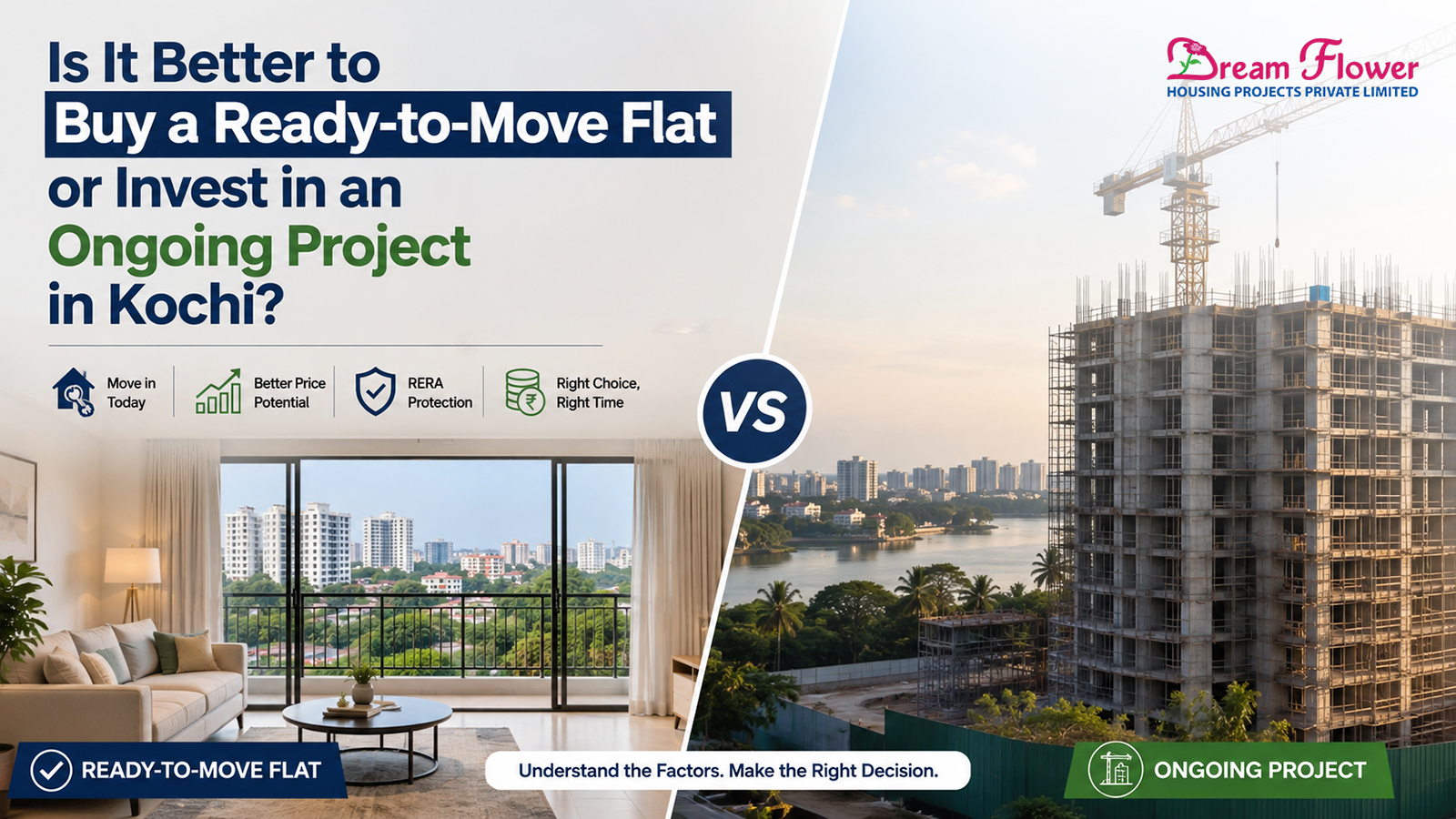
There’s a question that comes up in almost every flat-buying conversation in Kochi: do you pay a premium to move in today, or book early and wait hopefully getting a better price and a better unit? Both options have real merit. And both come with trade-offs that depend almost entirely on your situation, not on any universal rule. Let’s break down the key factors to consider before making your decision.
What “Ready to Move” Actually Means in Kochi
A Ready-to-move flat is exactly what it sounds like the building is complete, the occupation certificate is in hand, and you can move in within weeks of registering. In Kochi’s current market, ready-to-move inventory is spread across established neighbourhoods like Palarivattom, Edappally, and Tripunithura, often in projects that were launched two or three years ago and have since been delivered.
The obvious advantage is certainty. You can see the flat before you commit. The floor, the natural light, the actual dimensions of the living room, not the brochure version. There’s no waiting on a possession date that might shift by six months. And since GST doesn’t apply to completed properties, the effective cost difference between ready-to-move and ongoing flats in Kochi is sometimes narrower than it first appears.
The downside is price. Ready-to-move flats typically carry a 15–20% premium over comparable under-construction units in the same area.
What You’re Actually Getting With an Ongoing Project
Booking a flat in an ongoing project — one that’s under construction or just launched usually means a lower entry price, more time to arrange your finances, and greater choice of floor, facing, and configuration.
The concern, historically, has been trust. How confident can you be that the project will be delivered on time, and that it’ll match what was shown in the renders?
This is where K-RERA genuinely changed things for Kochi buyers. Kerala’s real estate regulator legally requires builders to maintain project-specific escrow accounts, register each project publicly, and meet possession timelines or face financial penalties. For buyers considering an ongoing project from a K-RERA approved builder, the risk profile today looks meaningfully different from what it was five or six years ago. That said, K-RERA protects you. It doesn’t eliminate delays entirely. Construction timelines can slip for reasons that have nothing to do with intent.
The Price Difference — Is It Worth the Wait?
An ongoing 2 BHK Flats in a well-located Kakkanad project might be priced at ₹75 lakhs today. A comparable ready-to-move unit nearby could be ₹88–90 lakhs. The ₹13–15 lakh gap looks decisive on paper.
But layer in what the wait actually costs: two years of rent if you’re living in a leased home, pre-EMI interest on your home loan during the construction period, and any finishing work a ready flat may already have covered for you. The gap narrows. It rarely disappears, but it narrows.
If you’re already in flexible rented accommodation and the project has a credible 18–24 month delivery timeline, the math still often favours the ongoing project but only if the builder has a verifiable track record of on-time handovers.
Who Should Go for a Ready-to-Move Flat
• You need to move within the next few months — school admissions, job relocation, or a lease ending
• You want to physically see the flat before committing — finishes, light, actual room sizes
• You’re not comfortable carrying home loan EMIs alongside rent for an extended period
• The specific ongoing projects in your preferred location don’t have a strong delivery record
Who Should Consider an Ongoing Project
• You’re in flexible rented accommodation with at least a year to wait
• You want more choice in floor, configuration, or facing
• You’re buying partly as an investment and want to benefit from the appreciation between booking and possession
• You’re working with a tighter upfront budget and need more time to arrange the balance
• The builder you’re looking at has a consistent, documented track record of delivering on time
Conclusion
A ready-to-move flat from an unreliable builder still carries risk — litigation over possession certificates is not unheard of. And an ongoing project from a builder with a strong delivery record can end up being the more sensible, more affordable decision.
In Kochi’s market right now with the metro network expanding, IT demand holding up around Kakkanad and Infopark, and new residential supply coming up in locations like Tripunithura and Chembumukku both options have a genuine case. Prices in well-connected corridors have appreciated steadily, which benefits ongoing-project buyers who got in early.
The question to ask yourself isn’t which option is better in general. It’s which option fits where you are right now your timeline, your finances, and the specific builder you’re evaluating. That last part matters more than most buyers realise. The builder’s track record should carry as much weight in your decision as the price difference.