

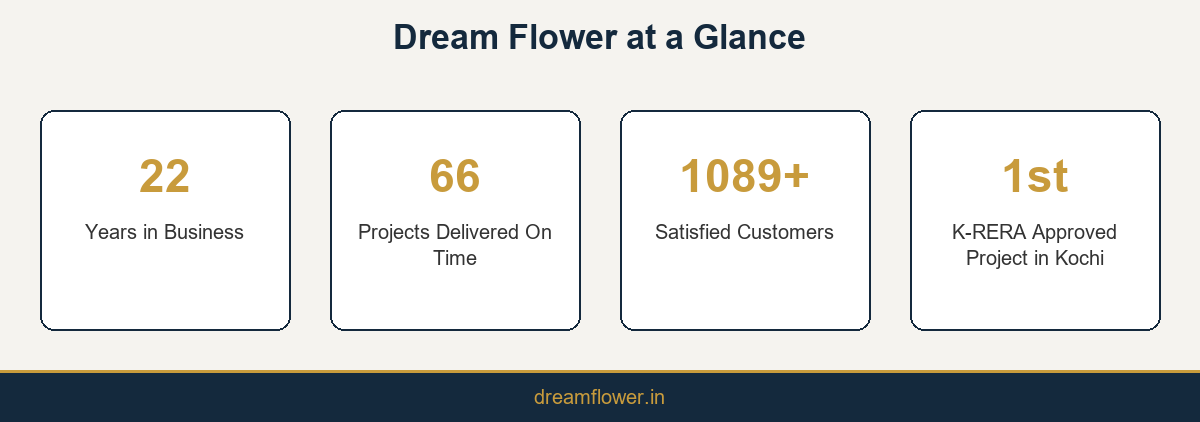
Buying an apartment in Kochi is one of the largest financial decisions a family or investor will make, and the biggest risk rarely lies in the apartment itself. It lies in the builder behind it. K-RERA approved apartments in Kochi give buyers a legal layer of protection that unregistered projects cannot offer, from verified land titles to enforceable possession timelines. Dream Flower Housing Projects has built 66 projects across 22 years, including Kochi’s first K-RERA builder approved project. This guide explains what K-RERA approval verifies, how all-inclusive pricing works, and why a builder’s delivery record matters more than its marketing.
Key Takeaways
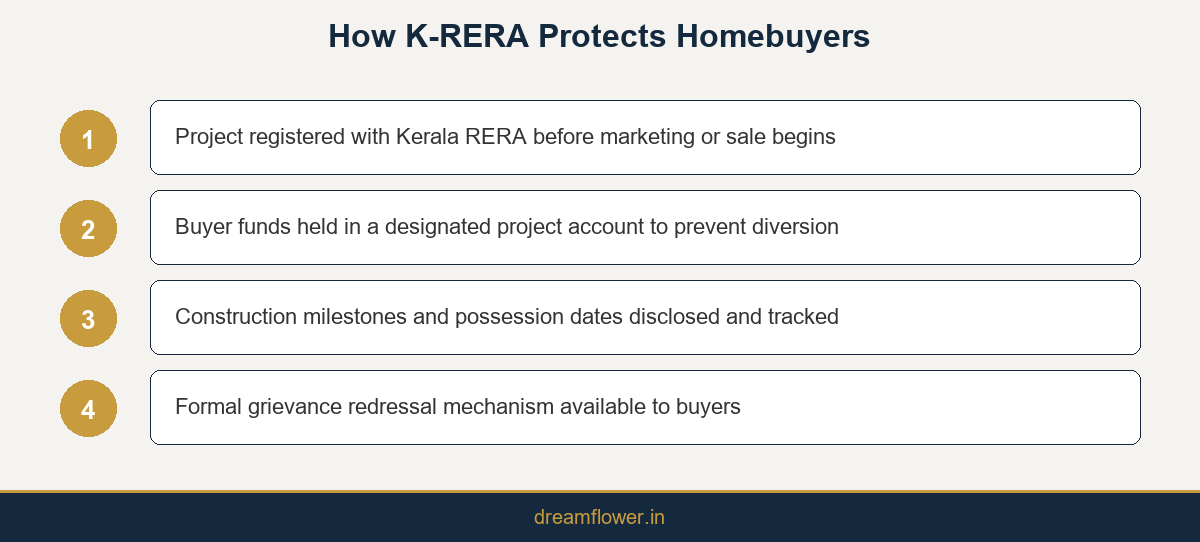
- K-RERA registration confirms land title, statutory approvals, and fund handling before a single flat is sold.
- All-inclusive pricing means car parking, GST, and electricity connection charges are already in the quoted price, with only registration paid separately.
- A track record of 66 projects delivered on time over 22 years is a stronger signal of reliability than any promotional claim.
What K-RERA Approval Actually Verifies
The Real Estate Regulatory framework, introduced under the Real Estate (Regulation and Development) Act, 2016, requires developers to register a project with the state authority, in Kerala’s case the Kerala Real Estate Regulatory Authority, before advertising or accepting bookings. Registration is not a formality. It requires the developer to disclose land title documents, statutory clearances, sanctioned building plans, and a committed possession date, all of which become part of the public record.
For a buyer, this changes the entire risk profile of the purchase. Instead of relying on a sales brochure or a verbal assurance from a site executive, a buyer can check the project’s registered status, its promised timeline, and any amendments to that timeline. Dream Flower’s distinction as the first K-RERA builder approved project in Kochi means this verification layer was in place from the earliest projects, not added later in response to regulation.
The registration record is also a living document rather than a one-time filing. If a developer needs to revise a possession date, change the sanctioned plan, or update project details, these amendments are filed with the authority and become visible to the public. This means a buyer is not limited to the promises made at the time of booking. They can return to the registration record at any point during construction and see whether the project remains on track against its own disclosed commitments, or whether the developer has already revised its timeline.
This transparency is particularly valuable in a market like Kochi, where apartment inventory spans everything from small, single-project builders to established developers with decades of history. A buyer comparing two projects at a similar price point can use the registration record as a neutral, third-party reference point rather than relying solely on what each developer’s sales team communicates during a site visit. It converts a subjective trust decision into an objective, checkable one.
What Gets Verified Before Registration
Before a project is registered, the authority checks the land title for encumbrances, confirms the building plan is sanctioned by the local body, and verifies that the promoter has legal rights to develop and sell the land. This removes the single biggest hidden risk in Indian real estate: buying into a project where the underlying land ownership is disputed or unclear.
What Happens If a Builder Skips It
A project that is not RERA registered can still be marketed informally, but it cannot legally accept advance payments in most cases, and a buyer has no regulatory body to approach if delivery is delayed or specifications are not honoured. This is the practical difference between a K-RERA approved residential apartment developer and one operating outside the framework.
Why Smaller Builders Sometimes Avoid Registration
Some smaller developers avoid registration by structuring sales as informal agreements below the regulatory threshold, or by delaying formal marketing until after most units are already committed through word of mouth. Buyers approached this way should treat the absence of registration as a reason for extra caution, not as a neutral detail to overlook.
Why All-Inclusive Pricing Protects Buyers
Hidden charges are one of the most common sources of dispute in Indian apartment purchases. A quoted price that excludes car parking, club membership, electricity connection, or GST can inflate the final cost by a significant margin, often disclosed only at the agreement stage.
Dream Flower’s all-inclusive pricing apartment developer approach folds car parking, GST, and electricity connection charges into the quoted price for every unit, so the number a buyer sees during a site visit is close to the number they will actually pay, with registration charges being the only separate line item. This matters most for first time buyers who are budgeting against a fixed loan eligibility and cannot absorb a late surprise.
Which developer offers transparent pricing apartments is a question worth asking directly during a site visit, and a builder confident in its numbers will answer it in writing, not verbally.
The practical effect of all-inclusive pricing shows up most clearly at the loan approval stage. Banks calculate loan eligibility against the total declared cost of the property, so if a buyer’s initial budget was based on a base price that excluded parking or GST, the loan amount sanctioned may fall short of the actual amount needed at registration. This gap often forces buyers to arrange additional funds at short notice, precisely at the point in the process when flexibility is lowest.
All-inclusive pricing also simplifies comparison across projects for buyers who are evaluating several developments in parallel, a common pattern for families comparing two or three shortlisted societies before deciding. When every quote already reflects the full cost, the comparison becomes a straightforward exercise of matching price against location, size, and amenities, rather than a spreadsheet exercise of adding back a different set of hidden charges for each competing developer.
There is a psychological dimension to this as well. Buyers who discover an unexpected charge late in the process, even a relatively small one, often carry that experience forward into how they perceive the entire transaction, sometimes souring an otherwise smooth purchase. Avoiding that late surprise by disclosing the full price upfront tends to produce a materially better buying experience, independent of the actual rupee amount involved.
This approach also reduces friction between the buyer and developer at the agreement drafting stage, which is often the most legally sensitive point in the entire transaction. When both parties are already working from a shared, written, all-inclusive figure, the agreement itself becomes a formality that confirms what was already agreed, rather than a negotiation that reopens the price at the last possible moment before signing.
Dream Flower’s Delivery Track Record
A builder’s history of possession dates is a better predictor of future performance than its current advertising. Dream Flower has delivered 66 projects across Kochi over 22 years, spanning neighbourhoods from Edappally and Kakkanad to Palarivattom and Tripunithura, serving over 1,089 customers to date.
An on-time possession track record builder reduces two of the most stressful costs of a delayed handover: continued rent payments on a current home, and interest paid on a loan for an apartment that is not yet livable. Buyers evaluating any Kochi developer should ask specifically how many of its last ten projects were delivered on the originally committed date.
This record spans a genuine mix of project types rather than a single successful development. Dream Flower’s portfolio includes larger developments with dozens of units alongside smaller, boutique projects, and it spans both fully completed, ready to move societies and current under-construction developments still progressing toward their committed possession dates. A track record built across this range of project sizes and stages is generally more reliable than one built on a single flagship project, since it demonstrates consistent execution rather than a single favourable outcome.
Why Delivery History Beats Renderings
Three dimensional renderings and show flats represent intent, not commitment. A builder’s actual delivery history, verifiable against RERA filings and past project handovers, is a far more reliable signal of whether a current project will be completed on schedule.
How to Read a Delivery Record
Ask not just how many projects were delivered, but how many were delivered against their originally filed possession date rather than a revised one. A developer with a long list of completed projects but a pattern of repeated timeline amendments tells a very different story than one with a shorter list and a consistent record of meeting its first committed date.
Where to Verify Independently
Beyond speaking with the developer directly, buyers can cross reference project completion against local municipal records, past K-RERA filings, and conversations with residents of older completed projects. Combining these sources gives a more reliable picture than relying on any single source, including the developer’s own claims.
How to Compare Developers on Pricing Transparency
When comparing two similarly priced projects in the same locality, the difference often comes down to what is included. A family-run developer with delivered projects that has built a reputation over decades typically has less incentive to obscure pricing, since repeat referrals depend on trust built over many transactions rather than a single sale.
A useful comparison framework is to ask each shortlisted developer for a written breakdown that separates the base price, statutory charges, optional add-ons, and registration costs. Any reluctance to provide this in writing is itself a signal worth noting before booking.
It also helps to ask the same set of questions of every developer being compared, in the same order, so responses can be evaluated side by side rather than from memory after several site visits. A simple written checklist covering base price, inclusions, exclusions, possession date, and K-RERA registration number turns what is often an emotional, showroom-driven decision into a structured comparison that is much harder for any single developer’s presentation style to distort.
Buyers should also be cautious of quotes that are unusually low relative to comparable projects in the same locality. A lower headline figure sometimes reflects a narrower scope of inclusions rather than a genuinely better price, and the gap tends to surface only once a buyer requests the full written breakdown described above.
Finally, it helps to time this comparison exercise before, not after, paying a token booking amount. Once a token amount changes hands, negotiating leverage on pricing transparency drops considerably, since the buyer has already signalled strong intent to proceed. Completing the written comparison across all shortlisted developers before any payment keeps that leverage intact for as long as possible.
What a Family-Run, Established Developer Offers
Scale is not the only measure of reliability. A family-run developer with a multi-decade presence in one city, such as Dream Flower’s 22 years across Kochi, tends to have deeper local relationships with contractors, local authorities, and repeat customers, all of which reduce execution risk on any single project.
This is different from choosing an ideal builder for first time homeowners based purely on the size of a marketing budget. Established developers with visible project history allow a buyer to physically visit older, completed projects and speak to existing residents before committing to a newer one.
There is also a continuity argument that matters after possession. A family-run developer with an ongoing presence in the same city is far more reachable years later for post-possession concerns such as structural warranty claims, common area maintenance handover, or association formation support, compared with a developer that completes a single project and has no further local presence. This after-sales continuity is rarely discussed during a site visit, but it becomes important within the first year or two of moving in.
For first time homeowners in particular, an established local developer can also provide more informal guidance through the buying process itself, from documentation requirements to coordinating with the same lending banks they have worked with across many previous projects, which can shorten timelines that might otherwise be unfamiliar territory for a first time buyer.
This local depth also tends to show up in how disputes, when they do occur, get resolved. An established developer with an ongoing reputation to protect in the same city has a stronger incentive to resolve a legitimate complaint quickly and fairly, compared with a developer whose business model depends on moving on to new markets after each project rather than sustaining a long-term local reputation.
Buyers should also weigh how a developer’s family involvement translates into decision making on-site. In many established, family-run developments, senior family members remain directly involved in reviewing construction quality and resolving buyer queries, rather than delegating every decision to a rotating set of sales staff. This closer involvement often correlates with faster resolution of the small, practical issues that come up during and after possession.
Financing a K-RERA Approved Apartment
Most Kochi apartment buyers finance their purchase through a home loan, and banks generally prefer to lend against K-RERA registered projects because the home loan assistance process is simpler when land title and approvals are already verified through registration.
For guidance on lending norms and documentation, the Reserve Bank of India publishes consumer facing information on housing finance that is useful background reading before approaching a specific bank.
For under-construction projects, loan disbursement is typically staged against construction milestones rather than released as a single lump sum. A bank’s technical team will usually verify progress before releasing each tranche, which means a builder’s track record of meeting its own construction schedule directly affects how smoothly this staged disbursement process goes for the buyer. Delays on the construction side can, in turn, delay each subsequent loan disbursement, compounding the original problem.
Buyers should also factor in that the all-inclusive price, rather than a base price, is the more accurate figure to share with a bank when requesting an eligibility estimate. Using a lower, incomplete figure can result in loan pre-approval for an amount that ultimately falls short once parking, GST, and other charges are added back in at the agreement stage.
Many buyers also underestimate the value of getting a written, project specific loan quote early in the process, before finalising a unit. A quote obtained early gives a realistic sense of monthly instalment obligations while there is still time to adjust the choice of unit size or configuration, rather than discovering an affordability gap only after a booking amount has already been paid.
A Checklist Before You Book
Before signing any booking form in Kochi, confirm the project’s K-RERA registration number, request a written all-inclusive price breakdown, ask for the developer’s last five possession dates against original commitments, and review the specific unit’s floor plan and carpet area against the project listing directly rather than a brochure alone.
These four checks take under an hour and remove most of the risk that turns an apartment purchase into a multi year dispute.
It is worth completing this checklist in writing, ideally as a short document both the buyer and the developer’s representative sign or acknowledge over email, rather than relying on memory of a verbal conversation during a busy site visit. This creates a simple, low effort paper trail that protects both sides if any detail is disputed later, and it signals to the developer that the buyer is evaluating the purchase carefully rather than deciding purely on emotion.
Finally, buyers should treat this checklist as a starting point rather than an exhaustive list. Depending on individual circumstances, additional questions around specific unit orientation, floor preference, or amenity access may matter just as much as the four core checks above, and should be added to the same written record before a booking amount changes hands.
Taken together, these checks take a purchase decision that often feels driven by instinct and convenience of location, and grounds it instead in a small set of verifiable facts. That shift does not remove the emotional weight of choosing a home, but it does remove most of the avoidable financial and legal risk that turns an otherwise good decision into a stressful one.
Conclusion
Every idea covered in this guide, from K-RERA registration to all-inclusive pricing to a verifiable delivery record, exists to answer one underlying question: can this specific claim be checked independently, or does it rely entirely on trusting the person making it. Buyers who insist on checkable answers to that question, project by project, consistently make safer purchase decisions than those who rely on a single site visit and a persuasive sales conversation. K-RERA approval, all-inclusive pricing, and a verifiable delivery record are not marketing terms. They are the three checks that separate a safe apartment purchase from a risky one. Dream Flower’s 22 years, 66 on-time projects, and status as Kochi’s first K-RERA builder approved developer give buyers a concrete track record to verify rather than take on faith. Contact Dream Flower to review current K-RERA approved projects and request a written pricing breakdown before you book.
Frequently Asked Questions
What does K-RERA approval mean for a Kochi apartment?
It means the project’s land title, statutory approvals, and pricing disclosures have been verified and registered with the Kerala Real Estate Regulatory Authority before the developer could legally market or sell units.
Is all-inclusive pricing common among Kochi builders?
No, many developers quote a base price and add car parking, GST, or electricity charges separately. Dream Flower includes these in the quoted price, leaving only registration charges as a separate cost.
How many projects has Dream Flower delivered?
Dream Flower has delivered 66 projects across Kochi over 22 years, serving more than 1,089 customers, including neighbourhoods such as Edappally, Kakkanad, Palarivattom, and Tripunithura.
Why does a builder’s possession track record matter?
A history of on-time handovers reduces the buyer’s financial exposure to double costs, such as paying rent and loan interest simultaneously while waiting for a delayed possession.
Can I verify a project’s K-RERA status myself?
Yes, registered projects are listed on the state RERA portal, where a buyer can check the registration number, promised possession date, and any amendments filed by the developer.
What should be included in an all-inclusive apartment price?
At minimum, car parking, GST, and electricity connection charges. Registration charges are typically the only cost a buyer pays separately at Dream Flower.
Does K-RERA approval affect home loan approval?
Banks generally find it easier to approve loans against K-RERA registered projects since land title and statutory approvals are already verified through the registration process.
Where can I see Dream Flower’s current projects?
Dream Flower’s project page lists current ongoing and completed developments across Kochi, including unit configurations, pricing, and availability for each project.
What is the difference between a registered and unregistered project?
A registered project has disclosed its land title, approvals, and timeline to the regulator and can legally accept bookings. An unregistered project offers no such regulatory recourse if delivery is delayed.
How do I get a price quote for a budget-friendly apartment in Kochi?
Contact Dream Flower’s sales team directly for a written, all-inclusive price breakdown for any current project, so the quoted number reflects the full cost before registration.