

Among the practical decisions facing apartment options for nri investors, choosing who represents you on the ground in Kochi is one of the most consequential and, often, the least examined. This guide sets aside the legal mechanics of Power of Attorney, covered in Dream Flower’s documentation guide, and focuses instead on how to choose and manage the person you actually give that authority to.
Key Takeaways
- Define exactly what your representative will handle before granting any authority.
- Agree on a reporting routine in writing before the first site visit takes place.
- Understand whether your representative works for you, the builder, or both.
Why This Decision Deserves as Much Care as Choosing the Builder
Buyers often spend weeks comparing builders, projects, and floor plans, then decide who will represent them locally in a single phone call with a family member or acquaintance.
This asymmetry is understandable. Evaluating a builder feels like the main decision, while choosing a representative feels like a logistics detail to sort out afterward. In practice, the representative is who actually attends site visits, reviews documents in person, and sometimes signs on your behalf, which makes this choice at least as consequential as the builder decision itself.
Treating it with the same deliberateness, rather than defaulting to whoever is most conveniently available, reduces the chance of a mismatch discovered only after authority has already been granted.
Defining Exactly What They Will Handle
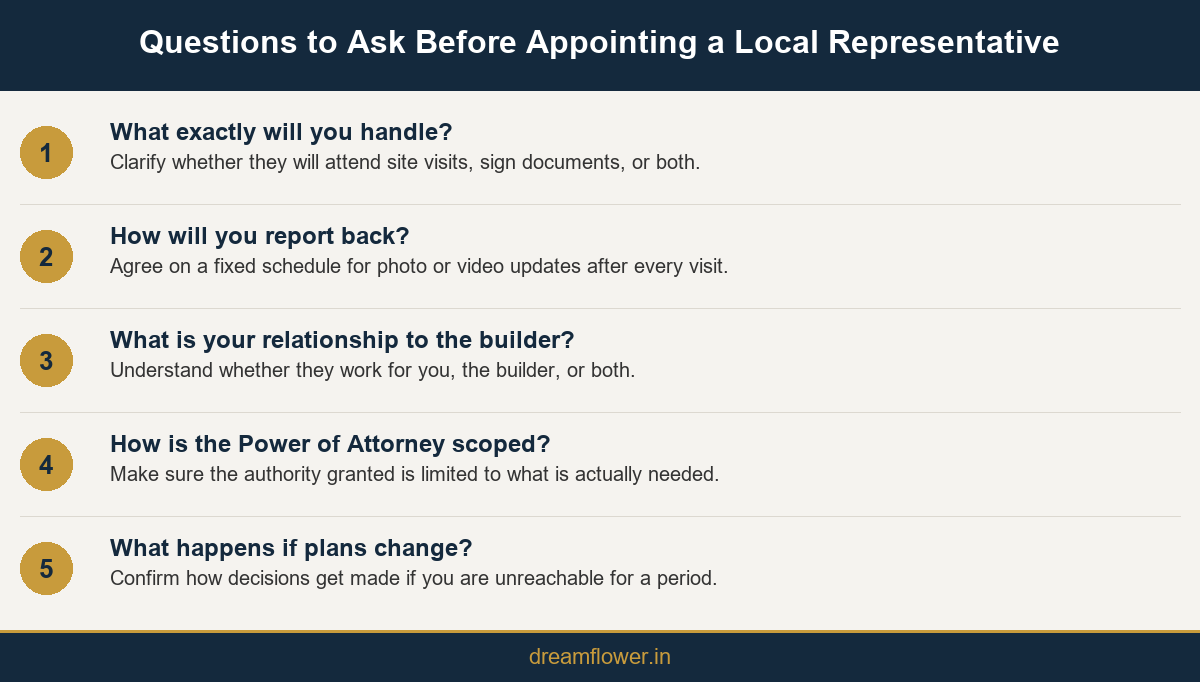
Before appointing anyone, write down specifically what tasks you expect them to perform. Attending site visits and sending photos is a very different scope from signing registration documents on your behalf, and conflating the two leads to confusion later.
Some NRI buyers split these roles between two people, one trusted contact for regular site monitoring and a separate, formally appointed Power of Attorney holder for legal signing. Others prefer a single person handling both. Neither approach is inherently better, but deciding deliberately, rather than by default, avoids gaps where neither person feels responsible for a given task.
Setting Up a Reporting Routine From the Start
Agree in advance on how often you expect updates, in what format, and through which channel. A representative who understands from day one that you expect a photo update after every site visit is more likely to provide one consistently than someone given a vague, open ended expectation.
This routine matters as much for your own peace of mind as for practical oversight. Remote ownership already involves less direct visibility than owning locally, and a predictable reporting rhythm narrows that gap meaningfully.
Where possible, put this expectation in writing, even in an informal message, so there is a shared record of what was agreed rather than a recollection that can drift over time.
Understanding Their Relationship to the Builder
It matters whether your representative is entirely independent of the builder or has some existing relationship, whether professional, financial, or personal. Neither situation automatically disqualifies someone, but it changes how you should weigh their advice.
A representative who also has a relationship with the builder may still act entirely in your interest, but it is worth understanding that connection upfront rather than discovering it later if a disagreement arises between what the builder claims and what your representative reports back to you.
Scoping the Authority You Grant
A Power of Attorney arrangement can be broad or narrow, and narrower is generally safer for a first time arrangement with any given representative. Limiting authority specifically to the transaction at hand, rather than granting open ended authority over your affairs generally, reduces exposure if the relationship does not work out as expected.
The exact legal drafting of this scope, along with notarization requirements, is covered in detail in Dream Flower’s dedicated NRI documentation guide. The point to take from this section is simply that scope is a decision you make deliberately, not a default that comes with appointing someone.
If your circumstances or the transaction change significantly, it is generally cleaner to revise the scope explicitly rather than relying on an informal understanding that the original authority should now cover something broader than originally intended.
Planning for When You Are Unreachable
Time zone differences between the Gulf and India, combined with an ordinary work schedule, mean there will be moments when a decision needs to be made and you are not immediately reachable.
Agree in advance on how minor decisions, such as scheduling flexibility for a site visit, should be handled without waiting for your direct approval, while reserving major decisions, such as accepting a change to the payment schedule, for your explicit sign off regardless of delay.
This distinction, decided calmly in advance, prevents both extremes, a representative who is paralysed without constant instruction and one who makes significant decisions you would have wanted to weigh in on yourself.
It is also worth agreeing on a fallback contact method for genuinely urgent matters, separate from your usual channel of communication, so a time sensitive issue is never stuck waiting on a single missed message.
Putting It All in Writing
None of the arrangements described in this guide need to feel formal or awkward to set up. A short written summary, even sent informally over email or messaging, covering scope, reporting routine, and decision boundaries, is enough to avoid most of the misunderstandings that arise from relying on memory alone.
This record also becomes useful if you later need to explain the arrangement to a lawyer, a bank, or the builder itself, since it removes ambiguity about what was actually agreed between you and your representative.
It also protects the representative themselves, since a clear written scope gives them confidence about what they are and are not authorised to decide, reducing the chance of an honest misunderstanding being mistaken for overreach.
Revisiting the Arrangement Over Time
A representative arrangement that works well during the purchase and initial construction phase may need to change once the property is handed over and shifts into a rental or personal use phase. The day to day tasks involved are different, and the person best suited to handle site visits during construction is not always the same person best suited to manage tenant relationships afterward.
It is worth revisiting the arrangement explicitly at each major milestone, booking, construction monitoring, handover, and ongoing management, rather than assuming the original arrangement should continue unchanged by default. A short check in conversation at each stage is enough to confirm whether the current setup still fits, or whether responsibilities should shift to someone better positioned for the next phase.
This kind of periodic review costs little time but avoids the situation where a representative originally appointed for a narrow purpose ends up handling responsibilities well beyond what either of you originally intended.
Conclusion
For apartment options for nri investors, the person representing you locally deserves the same level of scrutiny as the builder itself. Defining scope, agreeing on reporting, and understanding their relationship to the builder before granting any authority prevents most of the friction that arises later. For the legal mechanics of Power of Attorney and documentation, see Dream Flower’s dedicated NRI guide, or contact Dream Flower directly with questions about a specific project.
Frequently Asked Questions
Who should I appoint to represent me for a Kochi property purchase?
Someone whose role, scope of authority, and reporting routine you have clearly defined in advance, whether a family member, a professional representative, or a combination of both.
Should I give one person full Power of Attorney for everything?
Narrower is generally safer for a first arrangement. Limiting authority specifically to the transaction at hand reduces exposure if the relationship does not work out as expected.
How often should my representative send updates?
Agree on a specific cadence in advance, such as after every site visit, rather than leaving the frequency open ended and dependent on memory.
What if my representative also has a relationship with the builder?
This does not automatically disqualify them, but understand the connection upfront so you can weigh their advice appropriately if a disagreement arises.
Can I split site monitoring and legal signing between two people?
Yes, and many NRI buyers do exactly this, using one contact for regular updates and a separately appointed Power of Attorney holder for formal signing.
What decisions should I reserve for myself despite time zone delays?
Major decisions, such as accepting a change to the payment schedule, should wait for your explicit approval, while minor scheduling matters can be delegated.
Where can I learn about the legal requirements for Power of Attorney in India?
Dream Flower’s dedicated NRI documentation guide covers notarization and consulate attestation requirements in detail.