

Choosing a family-run developer with delivered projects over a newer, larger-marketing-budget builder is not a sentimental preference, it is a practical risk decision. This article explains what makes an established, family-run developer a reliable choice, and how to evaluate one before booking.
Key Takeaways
- A multi-decade, family-run developer typically has deeper local relationships that reduce execution risk.
- An established track record apartment developer can be evaluated against decades of completed projects, not just current marketing.
- A trusted apartment developer for remote buyers matters even more for NRI and out-of-town investors who cannot supervise construction directly.
Why Track Record Beats Marketing Budget
A larger marketing budget can make a newer developer appear more established than it actually is. A family-run developer that has operated continuously in one city for over two decades, such as Dream Flower’s 22 years in Kochi, offers a body of completed work that can be physically visited and verified, which no marketing campaign can substitute for.
Marketing spend is also, by nature, a recent and temporary signal. A developer can increase advertising sharply around the launch of a single project without that spend reflecting anything about how the previous project was delivered. A multi-decade track record, by contrast, compounds over time and becomes harder to fabricate or exaggerate with each additional completed project.
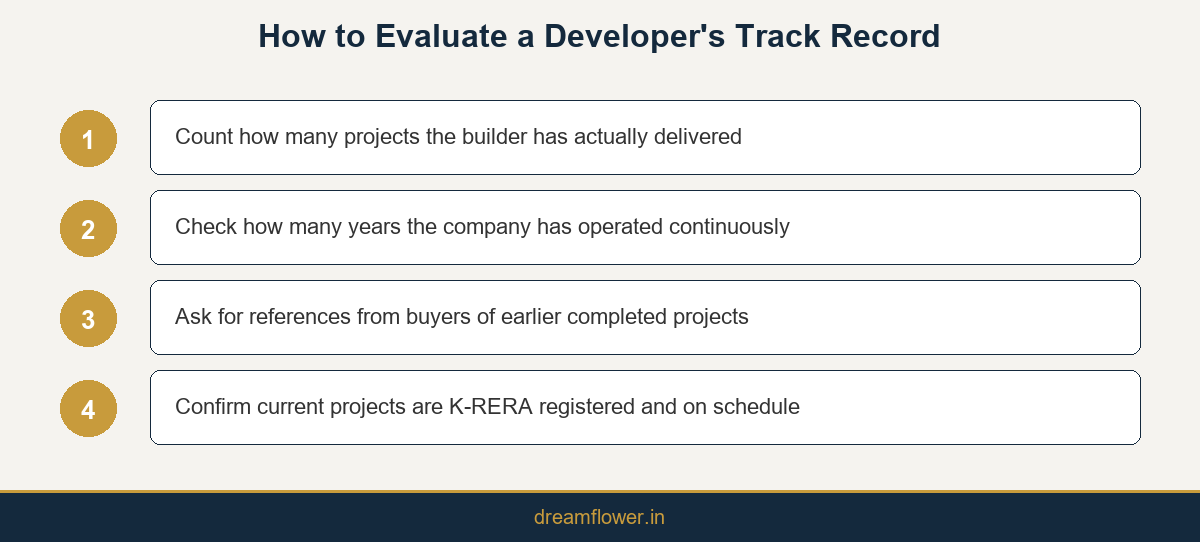
Buyers sometimes assume that a bigger, more visible advertising presence signals a larger, more capable organisation, but scale of marketing and scale of construction capability are not the same thing. The more reliable question is how many projects the developer has actually completed and handed over, not how prominently the current project is being promoted.
What to Look For in an Established Developer
An ideal builder for first time homeowners should be able to point to specific, named completed projects, such as Aurelius in Mamangalam or Vivaldi in Palarivattom, where a prospective buyer can speak directly with current residents about their experience.
Beyond simply naming past projects, a genuinely established developer should be comfortable with a buyer visiting these projects unannounced, rather than only through a scheduled, accompanied tour. The willingness to allow independent, unscripted conversations with existing residents is itself a meaningful signal, since it suggests the developer is confident about what those residents will say.
It is also worth asking how long the same core team, particularly site engineers and project managers, has been with the company. High turnover in these roles can disrupt continuity across projects even within an otherwise long-established company, while a stable core team tends to carry lessons and standards forward from one project to the next.
Why This Matters for Remote and NRI Buyers
For a trusted apartment developer for remote buyers, a long, verifiable local history matters even more, since remote buyers cannot visit the site regularly during construction. A developer’s established reputation within the local community becomes a proxy for the on-the-ground oversight a resident buyer would normally provide.
Remote buyers, particularly NRIs purchasing from abroad, often rely on family members or friends in Kochi to occasionally check on a project’s progress. An established developer with a strong local reputation makes this informal oversight easier, since local contacts are more likely to have independent knowledge of the developer’s standing, separate from anything the buyer has been told directly.
This local reputation also tends to translate into smoother remote transactions, from document handling to power of attorney arrangements, since an established developer has typically supported many similar remote purchases before and has a repeatable process for it, rather than treating each remote buyer as a new and unfamiliar situation.
How This Connects to Regulatory Compliance
Dream Flower’s status as Kochi’s first K-RERA approved builder reflects the same underlying discipline that comes with decades of continuous operation: a preference for verifiable compliance over informal assurances, built up across 66 delivered projects.
This connection is not a coincidence. Developers that plan to operate in the same city for decades have a much stronger long-term incentive to maintain a clean regulatory record than developers with a shorter time horizon, since any compliance failure has more time and more future projects through which it can damage the developer’s reputation.
Questions to Ask an Established Developer Directly
Beyond visiting completed projects, a short, direct set of questions can round out an evaluation: how many years has the company operated continuously in Kochi, how many projects has it delivered, how many of those met their original possession date, and can the company provide current resident contacts for at least two completed projects for independent reference.
A developer that answers these four questions clearly and without hesitation has usually already internalised the same standard of transparency this article describes, which is itself a reasonable predictor of how the rest of the buying process is likely to go.
What This Looks Like in Practice at Dream Flower
At Dream Flower, this evaluation plays out across a portfolio that spans smaller boutique developments alongside larger multi-unit projects, giving prospective buyers a genuine choice of reference points depending on the scale and locality they are considering, rather than a single flagship project used to represent the entire company.
The same leadership involvement that has guided the company since its founding continues across current projects, which buyers can verify directly by asking about who is responsible for construction oversight on any specific ongoing development they are considering booking into.
For buyers weighing Dream Flower against other shortlisted developers, the most useful exercise is a direct, side by side comparison: years in continuous operation, number of completed projects, and willingness to provide independent resident references. This comparison, applied consistently across every developer being considered, tends to be far more informative than comparing show flats or brochure design.
When a Newer Developer Might Still Be a Reasonable Choice
None of this means a newer developer is automatically a poor choice. Some newer companies are founded by professionals with substantial prior construction or project management experience gained elsewhere, even if the company itself is new. In these cases, a buyer should look at the individual track record of the people running the company rather than only the age of the corporate entity.
The key distinction is verifiability. Whether a developer is decades old or newly founded, the same underlying question applies: can their specific claims about experience, delivery, and pricing be checked against something concrete, such as previously completed projects, prior professional roles, or a K-RERA filing, rather than taken on trust alone.
For most buyers, however, an established, family-run developer with a long, verifiable local history remains the lower-risk default choice, simply because there is more evidence available to check. A newer developer can still be a reasonable option, but it places more of the verification burden on the buyer to independently confirm claims that an established developer can demonstrate directly through completed, visitable projects.
Ultimately, the decision comes down to how much independent verification a buyer is able and willing to do themselves. Buyers with the time and local network to thoroughly vet a newer developer may find a good option there, while buyers who prefer a lower-effort path to confidence are generally better served by a developer whose history is already established and easy to check.
Whichever direction a buyer leans, the underlying principle stays the same throughout this article: prioritise what can be independently verified over what is simply stated, and treat a developer’s willingness to support that verification, rather than resist it, as one of the most telling signals available before booking.
Conclusion
An established, family-run developer offers a track record that can be independently verified rather than taken on faith. Dream Flower’s 22 years and 66 delivered projects make it a trusted apartment developer for remote buyers and first-time homeowners alike. Contact Dream Flower to review completed projects before you choose a developer.
Frequently Asked Questions
Is a family-run developer more reliable than a large corporate builder?
Reliability depends on the specific developer’s track record rather than ownership structure, though a long-established family-run developer typically has strong local accountability.
How can I verify a developer’s track record?
Ask for a list of completed projects and visit them directly, speaking with current residents about their possession and construction experience.
Why does this matter more for NRI buyers?
NRI and remote buyers cannot supervise construction directly, so a developer’s established local reputation becomes an important substitute for on-site oversight.
How long has Dream Flower operated in Kochi?
Dream Flower has operated continuously in Kochi for 22 years, delivering 66 projects across multiple neighbourhoods.
Can I visit Dream Flower’s completed projects before booking?
Yes, visiting completed projects such as Aurelius or Vivaldi and speaking with residents is a practical way to evaluate the developer directly.
Does an established developer cost more than a newer one?
Pricing depends on the specific project and location rather than the developer’s age, though established developers often offer more predictable, all-inclusive pricing.
Is Dream Flower a K-RERA approved developer?
Yes, Dream Flower holds the distinction of being the first K-RERA builder approved project in Kochi.
What should first-time homeowners prioritise when choosing a developer?
Prioritise a verifiable delivery history, transparent pricing, and the ability to visit and evaluate the builder’s previous completed projects.
How many customers has Dream Flower served?
Dream Flower has served more than 1,089 customers across 66 delivered projects in Kochi.
Where can I request home loan assistance when buying from an established developer?
Dream Flower’s sales team can guide buyers through home loan assistance alongside project selection for any current development.