

A price quote from an all-inclusive pricing apartment developer should mean exactly what it says: the number quoted is close to the number paid, with no last-minute additions. This article breaks down what all-inclusive pricing actually covers, how it differs from a base price quote, and how to request an apartment price quote that holds up through to registration.
Key Takeaways
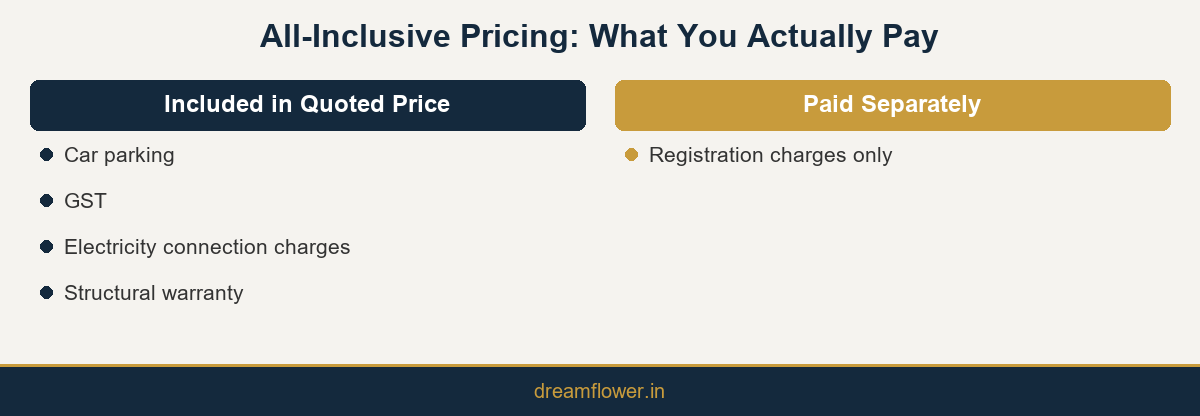
- All-inclusive pricing typically covers car parking, GST, and electricity connection charges within the quoted price.
- Registration charges are usually the only cost a buyer pays separately.
- Always request an apartment price quote in writing before booking, not just a verbal figure.
What All-Inclusive Pricing Actually Covers
At Dream Flower, the quoted price for a unit includes car parking, GST, and electricity connection charges, meaning these do not appear as additional line items after a buyer has already committed. Registration charges remain the one cost paid separately, since these are fixed by government rates rather than set by the developer.
This matters because these specific charges, parking, GST, and electricity connection, are among the most commonly disputed additions in Indian apartment purchases. Parking is sometimes sold as a separate, optional purchase even when a buyer assumed it was bundled with the unit. GST calculations can vary depending on how a developer structures the sale. Electricity connection charges are sometimes billed directly by the utility provider after possession, catching buyers who assumed this was already settled. Folding all three into the quoted price removes this ambiguity entirely.
Registration charges remain separate because they are calculated as a percentage of the property’s declared value under state government rules, and this rate is set independently of any individual developer. A transparent developer will still confirm this expected amount clearly at the time of quoting, even though the payment itself is made through the registration process rather than to the developer directly.
Why This Differs From a Base Price Quote
Many developers advertise a lower headline price that excludes parking, club membership, statutory taxes, or maintenance deposits, only disclosing the full cost once a buyer is already emotionally invested in a specific unit. A transparent pricing residential developer avoids this by presenting the complete figure upfront, even if it makes the initial number look less attractive on a listing site.
This pattern is common enough that experienced buyers in Kochi have learned to treat unusually low headline prices with some scepticism, specifically checking what has been excluded before assuming a project is genuinely more affordable than its competitors. The comparison only becomes meaningful once both figures reflect the same complete scope of charges.
A base price quote can also create friction later in the process, particularly once a buyer has already shared the figure with family members, a bank, or a broker as the expected total cost. Revising that figure upward after emotional and sometimes financial commitments have already been made tends to create far more frustration than encountering the same total cost stated clearly from the outset.
How to Request a Complete Price Breakdown
When you get an apartment price list from any Kochi developer, ask specifically whether the figure includes parking, GST, and utility connection charges, and request this confirmation in writing rather than relying on a verbal answer during a site visit. This single question resolves most pricing disputes before they happen.
It also helps to ask for the breakdown in a structured format, such as a simple table listing base price, GST, parking, electricity connection, and estimated registration charges as separate line items that sum to a clear total. This format makes it easy to compare across multiple shortlisted projects and makes any later discrepancy immediately obvious, since each component can be checked individually against the agreement.
How This Connects to K-RERA Disclosure
K-RERA registered projects are required to disclose pricing terms as part of their regulatory filing, which gives buyers an additional way to confirm that a developer’s quoted price matches what is officially declared, adding a layer of verification beyond the sales conversation alone.
This cross-check is particularly useful when a buyer is relying on a verbal quote from a site visit weeks or months earlier, since memory of exact figures can fade or become confused across multiple projects being compared. Returning to the official registration record provides a stable, unchanging reference point that does not depend on notes taken during a busy showroom visit.
A Worked Example of the Difference
Consider two hypothetical quotes for a similarly sized 2 BHK unit in the same locality, one priced at a lower headline figure that excludes parking, GST, and electricity connection, and one priced higher but genuinely all-inclusive. Once the excluded charges are added back to the first quote, the two totals often land very close together, sometimes with the originally lower quote ending up higher once every charge is accounted for.
This is why comparing headline prices alone, without first confirming what each figure includes, can lead a buyer toward a decision based on an incomplete picture. The only reliable way to compare is to request the same structured, itemised breakdown from every developer being considered, then compare the final totals rather than the advertised starting price.
Buyers who go through this exercise once, for a single pair of shortlisted projects, often find it changes how they evaluate every subsequent quote they receive, since the exercise makes the gap between headline and actual pricing immediately visible in a way it was not before.
How Loan Eligibility Ties Back to Pricing Clarity
Banks calculate loan eligibility against the declared, total value of a property, which means the all-inclusive figure is the correct number to use when approaching a lender for an estimate. Buyers who initially budget against a lower, incomplete base price sometimes discover a shortfall once the loan is formally processed against the true, complete cost.
This gap is easy to avoid by simply requesting the all-inclusive figure before, rather than after, approaching a bank, and it is one more reason why a clear, upfront breakdown from the developer benefits the buyer well beyond the initial comparison stage.
Building Pricing Transparency Into Your Own Buying Checklist
Rather than treating pricing transparency as a single question asked once during a site visit, it helps to build it into a short, repeatable checklist used for every developer under consideration: request the all-inclusive figure in writing, confirm what is excluded, cross check against the K-RERA filing, and use the same complete figure when approaching a bank.
Buyers who apply this checklist consistently, project after project, tend to make faster, more confident comparisons overall, since each new quote is evaluated against the same fixed set of questions rather than being judged fresh each time based on how the conversation happened to go.
This same checklist is worth revisiting at the agreement stage, immediately before signing, since it takes only a few minutes to confirm that the figures in the final agreement match what was disclosed earlier in writing. Catching a discrepancy at this stage, before signatures are exchanged, is far simpler than raising it afterward.
Sharing this same checklist with family members involved in the decision, particularly when a purchase is being made jointly or with financial support from parents, also helps ensure everyone involved is working from the same complete figure rather than an earlier, partial quote that was mentioned in passing during an initial conversation.
For NRI buyers coordinating a purchase remotely with family in Kochi, this written checklist becomes even more valuable, since it gives everyone involved, regardless of location, a single shared reference document rather than relying on a phone call summary that can lose detail in translation between conversations.
Kept consistently across every project a buyer seriously considers, this small discipline around written, all-inclusive pricing tends to save considerably more time and stress than it costs to set up, precisely because it front-loads the questions that would otherwise surface as disputes much later in the process.
Conclusion
All-inclusive pricing removes the guesswork from one of the largest purchases a family will make. By choosing a transparent pricing residential developer and insisting on a written breakdown before booking, buyers avoid the most common source of post-purchase disputes. Request an apartment price quote from Dream Flower to see the full, all-inclusive figure for any current project.
Frequently Asked Questions
What is typically included in all-inclusive apartment pricing?
Car parking, GST, and electricity connection charges are typically included in Dream Flower’s quoted price, leaving registration as the main separate cost.
Why do some developers not offer all-inclusive pricing?
A lower headline price can make a listing appear more competitive, even though the final cost after add-ons may be similar or higher than a transparently priced alternative.
Should I get a price quote in writing?
Yes, a written quote protects both parties and gives the buyer a clear reference to hold the developer accountable to at the agreement stage.
Are registration charges included in all-inclusive pricing?
No, registration charges are generally paid separately since they are set by government rates rather than the developer.
Does K-RERA registration require pricing disclosure?
Yes, registered projects must disclose pricing terms as part of their regulatory filing, giving buyers an independent way to verify a quoted price.
How can I compare pricing across different Kochi developers?
Request a written, itemised breakdown from each developer covering base price, statutory charges, optional extras, and registration costs, then compare the totals rather than headline prices.
Does all-inclusive pricing vary by project or unit size?
Yes, the final price depends on the specific unit’s carpet area and project, though the inclusion policy for parking, GST, and electricity remains consistent across Dream Flower projects.
Can pricing change after booking?
A written, all-inclusive quote at booking time is intended to prevent this, which is why confirming the breakdown in writing before payment matters.
Where can I see current project pricing?
Dream Flower’s project listing shows current price ranges for ongoing and completed developments across Kochi.
Is GST charged on top of the apartment price separately?
At Dream Flower, GST is included within the quoted all-inclusive price rather than added afterward as a separate charge.