

The price on a flat’s brochure is not the price you finally pay. On top of it come the stamp duty Kerala levies on the sale deed, a registration fee, and sometimes GST and loan charges. For a mid sized flat in Kochi these can add several lakh rupees. This guide explains the current rates, the fair value rule, the certificate every flat sale needs, a worked example and the other one time costs to budget for before you book.
Key Takeaways
- The stamp duty Kerala charges on a sale deed is 8%, plus a 2% registration fee, on the fair value or the price, whichever is higher.
- Flat sales need a valuation certificate before the deed can be registered.
- Under construction flats also attract GST, while flats sold after the completion certificate do not.
What Stamp Duty and the Registration Fee Are
Stamp duty is a state tax on the document that transfers ownership, the sale deed. The registration fee is a separate charge for recording that deed at the Sub Registrar’s office. Both are paid by the buyer unless the agreement says otherwise, and both are due before the deed is registered.
Both are paid in cash terms on top of the agreed price, and neither can be negotiated with the builder because they are statutory. The department’s ready reckoner sets out each rate by type of document, so the same table covers sale deeds, agreements, gifts and mortgages.
Registration matters because an unregistered sale deed does not give you clear legal title. Banks will not release a home loan against it, and you cannot easily resell or mortgage the flat later.
In Kerala, the rates are set by the state and published by the Kerala Registration Department. The rate is the same whether the flat sits in a corporation, a municipality or a panchayat.
There is also a smaller charge earlier in the process. If you sign a registered agreement to sell, it carries a fixed Rs 200 stamp duty plus a registration fee of 2% of the advance paid.
Current Rates and the Fair Value Rule
According to the department’s ready reckoner, the stamp duty Kerala applies to a sale deed is 8% and the registration fee is 2%. Together that is 10% of the value of the transaction.
The value used is the higher of two numbers: the consideration written in the deed, and the fair value fixed by the government for that property. Fair values are notified for land across the state, and they rose in recent years. The Kerala budget of 2023 proposed a 20% increase in land fair values.
The same 2023 budget also announced a higher duty for flats transferred within six months of the building number being allotted. Rules like this can change with each budget, so confirm the current rate for your transfer with the Sub Registrar or your lawyer before you budget.
Rates also change over time, so always use the department’s latest official ready reckoner of rates and fees rather than a figure from an old article, including this one.
Fair value also explains why two similar flats can attract different duty. A building on land with a higher notified fair value may face more duty even at the same price, so ask the builder or your lawyer which value will apply before you sign.
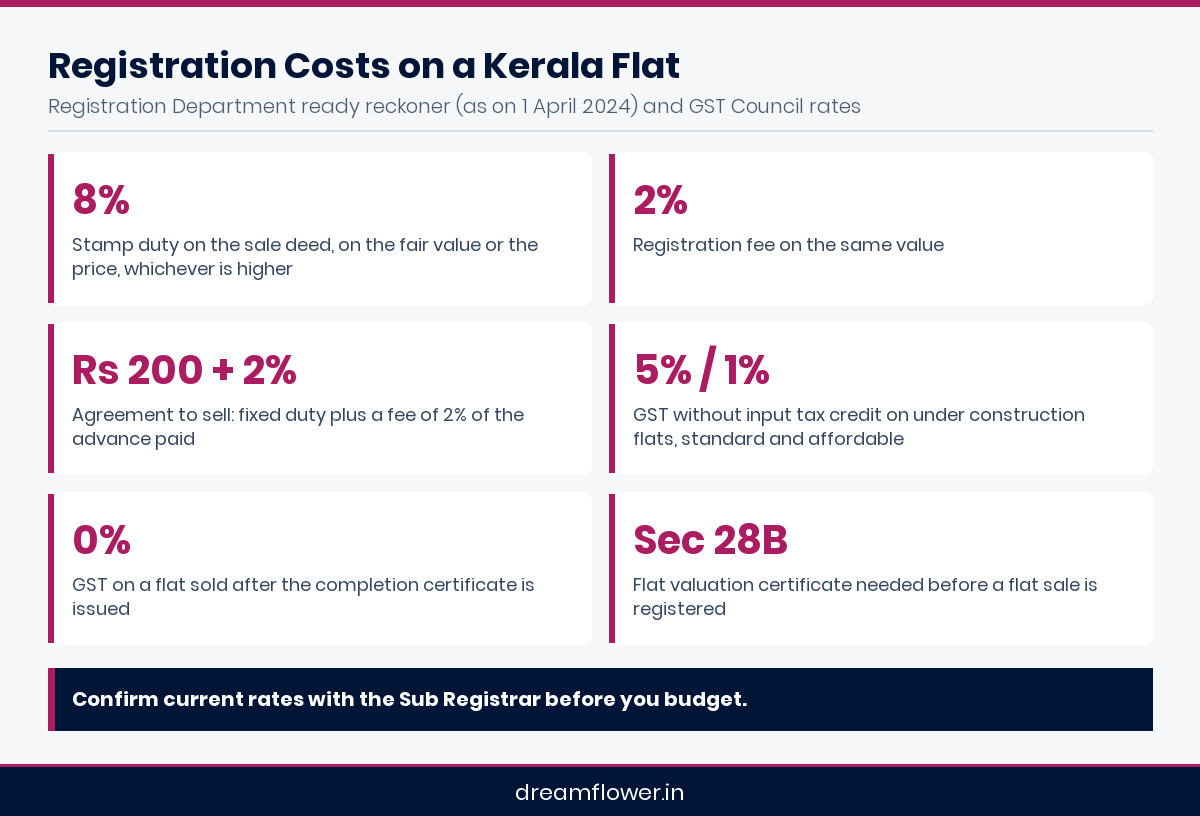
Infographic 1: The main registration costs on a Kerala flat purchase
The Flat Valuation Certificate
Flats have one extra step in Kerala. Since 2016, a registering officer will not register the transfer of a flat or apartment unless it comes with a valuation certificate under Section 28B of the Kerala Stamp Act. The certificate states the value of the flat, which feeds into the duty calculation.
A 2016 government order widened the list of people who can issue it. Besides the local body, it now includes certain government engineering departments, chartered engineers, approved valuers and registered architects or engineers.
In practice, your builder or lawyer usually arranges the certificate as part of the registration paperwork. Ask who will provide it, what it will cost and how long it takes, so the registration date does not slip.
Because the certificate sets the value of the flat itself, ask to see it before the registration day and check that the area and details match your agreement. A mismatch found at the Sub Registrar’s office can delay the registration and, with it, the release of your home loan.
Keep a copy with your sale deed. It is useful later for resale, for loans against the property and for any tax questions.
A Worked Example on a Sample Flat
Here is an illustrative example. It is not a quote for any Dream Flower project. Assume a ready to move flat where the deed value, after comparing the price with the fair value, is Rs 80 lakh.
Stamp duty at 8% would be Rs 6.4 lakh. The registration fee at 2% would be Rs 1.6 lakh. Together that is Rs 8 lakh, before the valuation certificate, legal fees and any loan related costs.
If the same flat were bought under construction, GST would also apply to the construction contract. Under the rates set by the GST Council in 2019, residential flats attract 5% GST without input tax credit, or 1% for homes that meet the affordable housing definition. Flats sold after the completion certificate is issued attract no GST at all. Ask the builder to show how GST is calculated in your price.
Most banks expect these one time costs to come from savings, which changes how much cash you need on registration day. Our article on buying with or without a housing loan looks at that trade off. Our guide to all inclusive pricing with no hidden charges explains which costs a builder should state upfront.
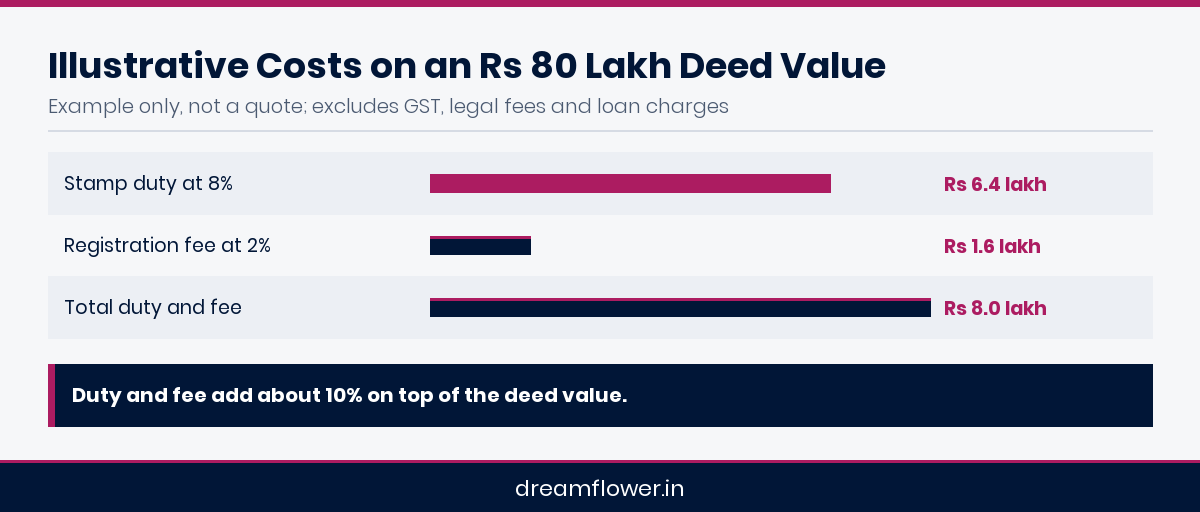
Infographic 2: Illustrative registration costs on an Rs 80 lakh deed value
Other One Time Costs to Budget For
Beyond duty, fees and GST, plan for legal fees for title verification and drafting, the valuation certificate, home loan processing fees, and the cost of a registered loan agreement if your bank requires one. Many projects also collect advance maintenance, a corpus fund and connection charges for electricity and water at handover.
Then there are the costs that arrive after registration: moving, basic furniture, curtains and appliances. They are not taxes, but they draw on the same savings in the same month, so put them in the plan too.
Some of these may be included in an all inclusive price and some may not. Ask for a written cost sheet that lists each item, and compare projects on the total rather than the headline rate. A cost sheet also protects you later, because it records what was promised as included at the time you booked, which helps if questions arise at handover.
There is a tax benefit to note. Stamp duty and registration costs for a residential house have counted within the overall Rs 1.5 lakh limit of Section 80C under the old tax regime. From April 2026, the Income Tax Act, 2025 carries that deduction in Section 123, so check the current rules with your tax adviser.
A simple habit helps here: add roughly the duty, fee and GST to every price you see while you are still browsing. It keeps the comparison honest between a ready flat and one still under construction.
If you are working to a tight budget, these costs matter even more. Our guide to the best areas for budget friendly homes in Kochi shows where your money goes further.
Conclusion
The stamp duty Kerala levies on a flat is 8%, with a 2% registration fee, both on the higher of the price and the fair value. Add the flat valuation certificate, GST on under construction homes, legal fees and loan costs, and the total can run to several lakh rupees. Build these into your budget before you book, and ask for a written cost sheet. If you would like an itemised estimate for a Dream Flower project, contact our sales team and we will walk you through it.
Frequently Asked Questions
Stamp duty Kerala rates: what do flat buyers pay?
The stamp duty Kerala charges on a sale deed is 8% of the fair value or the consideration, whichever is higher, according to the Registration Department’s ready reckoner. A 2% registration fee is charged on the same value. Confirm current rates before registering.
Is stamp duty charged on the fair value or the price?
It is charged on whichever is higher. If the price in the deed is below the government’s fair value for the property, duty is calculated on the fair value. If the price is higher, duty is calculated on the price.
What is the registration fee for property in Kerala?
The registration fee on a sale deed is 2% of the same value used for stamp duty. A registered agreement to sell carries Rs 200 stamp duty and a registration fee of 2% of the advance or earnest money paid.
Do I need a valuation certificate to register a flat in Kerala?
Yes. Since 2016, a flat or apartment transfer is not registered without a valuation certificate under Section 28B of the Kerala Stamp Act. Local bodies, approved valuers, chartered engineers and registered architects can issue it.
Is GST payable on a ready to move flat?
No. There is no GST on a flat sold after the completion certificate has been issued. Under construction flats attract 5% GST without input tax credit, or 1% for homes meeting the affordable housing definition.
Can I claim a tax deduction for stamp duty?
Stamp duty and registration costs for a residential house have qualified within the Rs 1.5 lakh Section 80C limit under the old regime. The Income Tax Act, 2025 moved this to Section 123, so confirm eligibility with a tax adviser.
Can stamp duty be included in a home loan?
Banks usually finance a percentage of the property value and expect the buyer to pay stamp duty and registration from savings. Our guide on how K-RERA registration affects loan approval covers what lenders check before they disburse.
How can I reduce the total cost of registration?
You cannot negotiate the statutory rates, but you can compare projects on total cost, check the fair value used, and plan the registration date. Our transparent pricing guide lists the questions to ask any builder.