

Few things disrupt a homebuyer’s finances more than a delayed possession. An on-time possession track record builder protects buyers from paying rent and loan interest simultaneously while waiting for a home that should already be ready. This article explains how to evaluate a builder’s delivery history and why it matters more than showroom promises.
Key Takeaways
- Delayed possession forces buyers to pay rent and loan interest at the same time, a significant hidden cost.
- An established track record apartment developer can show verifiable past possession dates, not just future promises.
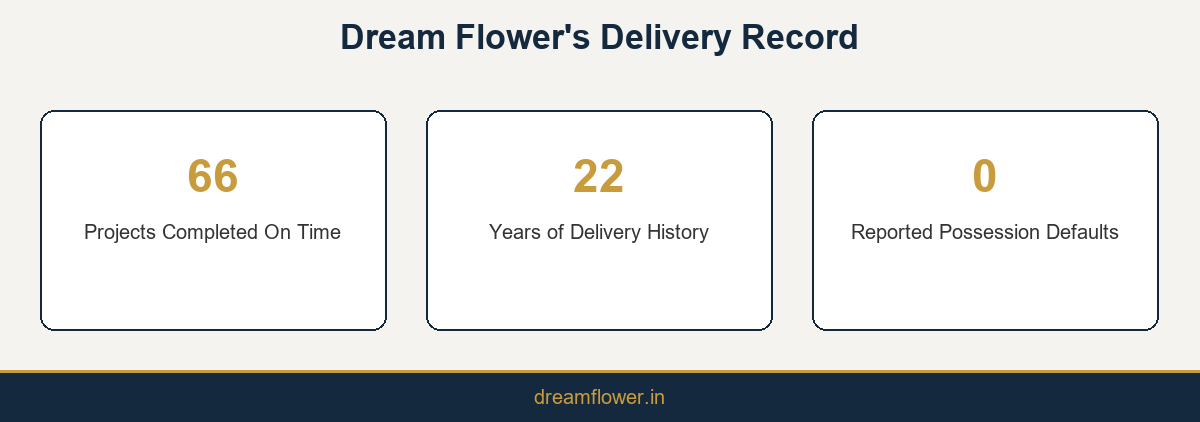
- Dream Flower has delivered 66 projects on time across 22 years in Kochi.
The Real Cost of a Delayed Possession
When possession is delayed, a buyer typically continues paying rent on their current residence while also servicing a home loan on the unfinished apartment, effectively paying for two homes at once. Over a delay of even six months, this can add a meaningful, unplanned cost on top of the purchase price itself.
Beyond the direct financial cost, a delayed possession also disrupts planning that families often build around a specific handover date, from school admissions timed to a new neighbourhood to notice periods given on a current rental. These downstream disruptions rarely show up in a cost calculation, but they are frequently cited by buyers as the most stressful part of a delayed handover, sometimes even more than the additional money involved.
There is also an opportunity cost that is easy to overlook. Funds committed to a delayed project cannot be redirected elsewhere, and buyers sometimes find themselves unable to take advantage of other opportunities, whether investment or personal, because their capital remains tied up in a purchase that has not yet delivered the asset they paid for.
How to Check a Builder’s Delivery History
A developer known for on-time possession record should be able to show, project by project, how many of its last ten deliveries met the originally committed date. This information is often available through K-RERA filings, which record the promised possession date and any amendments filed against it.
Beyond the filings themselves, a practical step is to request a simple list of the developer’s last several completed projects along with their original and actual possession dates side by side. A developer confident in its own record will usually provide this without hesitation, since it reflects positively on their business. Reluctance to share this specific comparison is itself worth noting as a caution sign.
It also helps to ask about the reasons behind any documented delays, where they occurred. Some delays stem from factors genuinely outside a developer’s control, such as regulatory changes or extreme weather events, while others reflect internal planning or cash flow issues that are more likely to recur on a current project. Understanding the difference gives a more nuanced picture than a simple on-time or delayed classification.
Dream Flower’s Delivery Record
Dream Flower has completed 66 projects over 22 years across Kochi, serving more than 1,089 customers. This includes both ongoing developments such as Deoserene near Petta Metro Station and completed, ready-to-move projects across multiple neighbourhoods, giving prospective buyers a large, visitable body of past work rather than a single reference project.
This scale of delivery history means a prospective buyer is rarely limited to a single reference point when evaluating the builder. Depending on which part of Kochi a buyer is considering, whether Edappally, Kakkanad, Palarivattom, or Tripunithura, there is typically a nearby completed Dream Flower project that can be visited directly, with current residents available to speak to about their own possession experience.
Consistency across this many individual projects, spanning different sizes, price points, and construction periods, is a more meaningful signal than a single successful development, since it demonstrates that on-time delivery reflects an operational discipline rather than a favourable outcome on one particular project.
Why This Matters More Than Show Flats
A show flat demonstrates finish quality, not delivery reliability. Speaking with residents of a builder’s older, completed projects and asking directly about their possession experience gives a far more accurate picture of what to expect from a current booking.
A show flat is, by definition, already complete and staged to look its best, which tells a buyer very little about how reliably that same developer manages construction timelines across an entire project from groundbreaking to handover. The two are related but distinct questions, and buyers who focus only on the show flat risk overlooking the more important one.
A short conversation with two or three residents of a completed project, ideally chosen independently rather than introduced by the developer’s sales team, can surface practical details about the possession process, including whether the promised date held, what documentation was required, and how smoothly the handover itself was managed.
What to Do If a Project Has Already Missed a Date
If a project a buyer is already committed to has missed its originally disclosed possession date, the first step is to check whether the developer has filed a formal amendment with the regulator explaining the revised timeline, since this at least keeps the disclosure obligation intact even though the delay itself is unwelcome news.
The second step is to request a written, updated timeline with a specific new date, rather than an open-ended assurance that completion is close. A specific date, even a delayed one, gives a buyer a concrete point to plan around and a clear reference to raise a formal complaint against if it is missed again.
Buyers facing repeated delays on an existing booking should also review what remedies are available to them under the regulatory framework, since delayed possession is one of the specific categories of complaint the framework was designed to address, distinct from the pre-booking verification steps covered earlier in this article.
Throughout this process, keeping a written record of every communication from the developer about the revised timeline is useful, since it creates a clear history if a formal complaint becomes necessary later. Verbal reassurances that a project is close to completion are far harder to act on than a dated, written commitment to a specific new possession date.
Building Possession Track Record Into Your Comparison
When comparing multiple shortlisted developers, treat possession track record as a scored criterion alongside price and location, rather than a background detail mentioned once and then set aside. Assign each developer a simple rating based on how many of their recent projects met original commitments, and weigh this alongside pricing and locality preferences when making a final decision.
This structured approach helps counter the natural tendency to weigh a favourite locality or an attractive show flat more heavily than a builder’s actual delivery history, even though delivery history is often the better predictor of how satisfied a buyer will be with the purchase two or three years later.
Over time, this kind of structured comparison also becomes easier to apply, since a buyer who has already gathered possession data on two or three developers for one project can reuse much of that research if they later consider a different project from one of the same developers.
It is also reasonable to weight recent projects more heavily than older ones when scoring a developer’s track record, since construction teams, supply chains, and local regulatory conditions can change over a decade or more. A strong record from many years ago is a positive sign, but a strong record maintained consistently into the last two or three years is a stronger one.
Finally, keep in mind that a possession track record is a probabilistic signal, not an absolute guarantee. A developer with an excellent history can still face an unexpected delay on a specific project, but a long, consistent record materially lowers that probability compared with a developer who has no comparable history to point to.
Conclusion
A builder’s possession track record is one of the most concrete, verifiable signals available before booking. Dream Flower’s 66 projects delivered on time across 22 years reflects a K-RERA approved process built around accountability. Contact Dream Flower to review possession history for any current project before you commit.
Frequently Asked Questions
Why is on-time possession important when buying an apartment?
Delayed possession often forces buyers to pay rent and loan interest simultaneously, adding a significant unplanned cost on top of the purchase price.
How can I check a builder’s possession track record?
Ask for the developer’s last several completed projects and their original versus actual possession dates, which can be cross checked against K-RERA filings.
How many projects has Dream Flower delivered on time?
Dream Flower has delivered 66 projects on time across 22 years in Kochi, serving more than 1,089 customers.
Does K-RERA registration guarantee on-time possession?
It requires the developer to disclose a committed possession date and file amendments if it changes, which improves accountability though it does not eliminate delay risk entirely.
What questions should I ask about possession before booking?
Ask for the builder’s last five possession dates against original commitments and whether the current project’s timeline has already been amended.
Can I visit Dream Flower’s completed projects before booking a new one?
Yes, visiting completed projects and speaking with current residents is one of the most reliable ways to evaluate a builder’s actual delivery performance.
Are under-construction projects riskier than ready-to-move ones for possession delay?
Under-construction projects carry more inherent timeline risk since possession has not yet occurred, which makes the builder’s historical track record especially important to review.
How does all-inclusive pricing relate to possession timelines?
Both reflect the same underlying discipline: a developer that discloses pricing transparently tends to also commit to and meet transparent delivery timelines.
What compensation exists if possession is delayed?
Regulatory frameworks generally provide for buyer remedies in case of delay, though the specific terms should be confirmed in the agreement and with the relevant authority.
Where can I get home loan assistance for a project with a strong possession record?
Dream Flower’s sales team can guide you toward projects with a demonstrated on-time delivery history and connect you with home loan assistance for the purchase.