
The price of a flat is paid once. The monthly maintenance bill keeps arriving for as long as you own it. Yet many buyers compare projects on rate and location, then discover the running cost only at handover. This guide explains how apartment maintenance charges are usually worked out, what they tend to pay for, how a corpus fund differs from the monthly bill, when GST applies and how to compare two flats fairly before you book.
Key Takeaways
- Apartment maintenance charges pay for shared services and common areas, not repairs inside your own flat.
- No law sets a rate per square foot, so compare what each charge includes as well as what it costs.
- Ask in writing who collects the money before the association takes over, and what happens to any deposit.
How Apartment Maintenance Charges Are Worked Out
Most Indian buildings quote the monthly charge as a rate per square foot. Multiply the rate by the area used for billing and you have the bill. A flat billed on 1,000 square feet at a rate of Rs 3 would pay Rs 3,000 a month. Always ask which area is used, because carpet area and super built up area give very different totals.
Some associations use a different method. Under the Kerala Apartment Ownership Act, 1983, where owners have registered their building under it, common expenses are shared according to each owner’s percentage of undivided interest in the common areas. That percentage is based on the value of the apartment, so it may not follow floor area exactly. Registration under this Act is not automatic, so ask whether your building will come under it.
Neither that Act nor the Real Estate (Regulation and Development) Act, 2016 sets a rate. The figure comes from the building’s own budget: what it costs to run the place, divided among the owners. That is why two similar buildings on the same road can charge different amounts.
We looked for a reliable published rate for Kochi and did not find one. Treat any single number you see quoted as a rough claim rather than a benchmark, and ask each builder for its own estimate.
What the Monthly Charge Usually Pays For
The charge covers the things no single owner controls. The RERA Act’s definition of common areas gives a good checklist: stairs, lifts and lobbies, terraces, parks and play areas, open parking, central services such as electricity and water, tanks, sumps and motors, and community facilities.
In practice, that usually means staff such as security and housekeeping, lift servicing, generator fuel and upkeep, common lighting, pumps and water tanks, and firefighting equipment. Facilities add to the list. A health club, an association hall or a large garden each needs cleaning, repairs and sometimes staff, so a building rich in amenities often costs more to run.
It does not usually cover what happens inside your flat. A leaking tap or a failed appliance is normally your own cost, although the builder has separate duties for defects. Our guide to looking after a flat you own covers that side of upkeep, and our note on common utility problems in Kochi flats explains what to ask about water and power.
Design also plays a part. Dream Flower’s own approach, described on its specialities page, is to design projects to reduce monthly maintenance costs. Whichever builder you consider, ask what running costs were planned for and which services the estimate assumes.
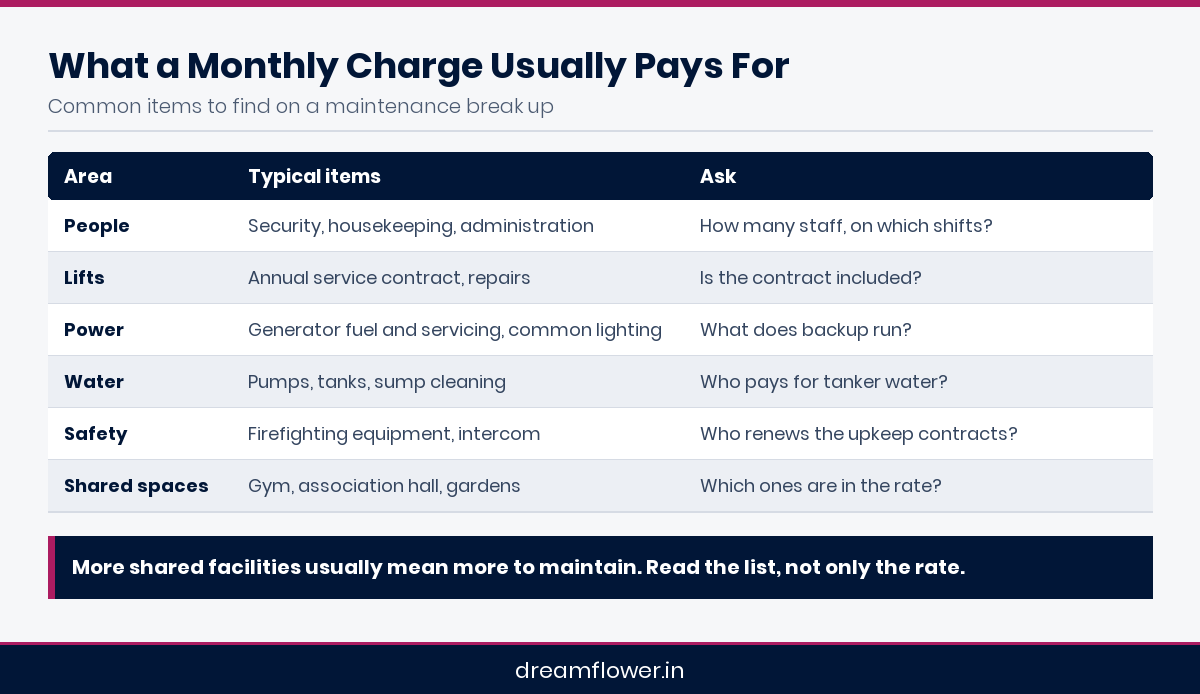
Infographic 1: What a monthly maintenance charge usually pays for
Corpus Fund, Advance Payments and Who Collects Them
A corpus fund, sometimes called a sinking fund, is a one time deposit meant for large future costs such as replacing a lift or repainting the building. Advance maintenance is a prepayment of the monthly bill. They are different things, and a project may collect one, both or neither.
Neither the RERA Act nor the Kerala Apartment Ownership Act mentions a corpus fund, so its amount and use depend on your agreement and the association’s rules. Ask how much is collected, when it is due, whether it sits in a separate account and when it passes to the association.
The timing matters. Under Section 11 of the RERA Act, the promoter must provide and maintain essential services, on reasonable charges, until the association of allottees takes over. The promoter must also pay any maintenance charges it has collected from buyers until it transfers physical possession.
After that, the duty moves to you. Section 19 requires allottees to pay their share of maintenance charges on time, with interest on delayed amounts, and to take part in forming the association. Where the 1983 Act applies, you cannot avoid your share by choosing not to use a facility, and a buyer of a resale flat can become liable for the seller’s unpaid dues. So ask for a statement of dues before you buy a resale home.
GST and Comparing Two Flats Fairly
GST can apply to the bill. A CBIC circular on residential welfare associations says that an association’s supply to its members is exempt up to Rs 7,500 per month per member. GST at 18% applies only when the charge is above that limit and the association’s annual turnover is above Rs 20 lakh. The limit applies separately to each flat a person owns.
The circular’s example taxes the whole amount once the limit is crossed. The Madras High Court held in 2021 that only the excess is taxable, and a 2025 Kerala High Court ruling has also questioned how GST applies to associations. Please check the current position with your association or a tax adviser.
To compare two flats, put both on the same basis. Take the rate, multiply it by the same kind of area and work out the yearly cost. The illustrative sum below shows why a lower rate on a larger area can still be close to a higher rate on a smaller one. Then compare what each charge includes.
For anyone looking at budget flats in Kochi, this bill deserves as much attention as the EMI, because it runs alongside the loan every month. Our guide to the best areas for budget friendly homes looks at where your money goes further.
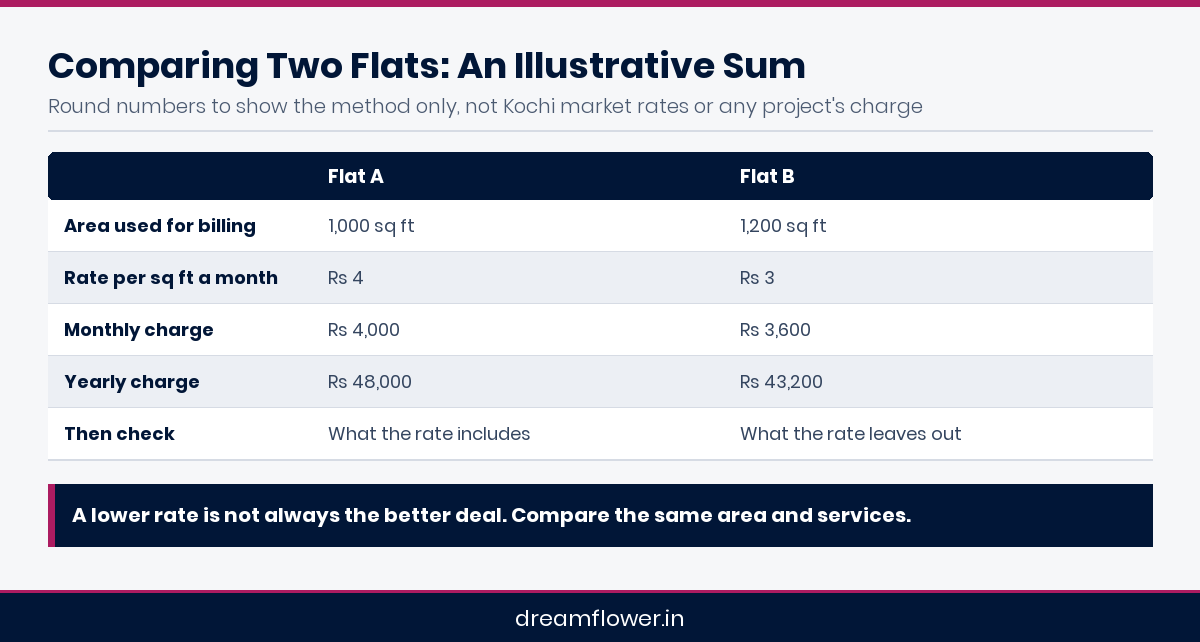
Infographic 2: An illustrative comparison using round numbers, not market rates
Questions to Ask Before You Buy
Start with the estimate. What is the expected monthly charge, on which area, and which services does it assume? Ask for the list in writing. A figure with no break up is hard to compare and easy to dispute later.
Then ask about the first few years. Who runs the building until the association takes over? Is any advance maintenance or corpus collected, and how much? When will the association be formed, and what documents will it receive? Our tips before you sign the buying agreement list other clauses worth reading.
For a completed building, go further. Ask to see the association’s recent accounts, how much is unpaid by other owners and whether a large repair is coming. A low charge can simply mean that repairs are being postponed, and owners may then face a larger bill all at once in a later year.
Finally, think about your own use. A family that will use the gym and pool daily may be happy to pay for them. A couple who travel often may prefer a simpler building. Either choice is fine, provided the cost is clear before you book. A written all inclusive cost sheet helps here too.
Conclusion
Apartment maintenance charges are a long term cost that deserves the same attention as the price. Find out how the figure is worked out, what it includes, who holds any deposit and whether GST applies. Then compare flats on the same basis and read the agreement before you sign. If you would like to discuss the running costs of a specific Dream Flower project, contact our sales team and ask for the details in writing.
Frequently Asked Questions
What are apartment maintenance charges?
They are regular payments that owners make for running a building’s shared services and common areas, such as security, housekeeping, lifts, generator upkeep, common lighting and water pumps. They do not normally cover repairs inside your own flat.
Is there a fixed rate for maintenance charges in Kochi?
No law sets a rate per square foot, and we did not find a reliable published figure for Kochi. The amount comes from each building’s own running costs, so ask every builder for a written estimate with a break up.
What is the difference between a corpus fund and monthly maintenance?
A corpus fund is a one time deposit kept for large future costs, such as replacing a lift. The monthly charge pays for routine running costs. Neither the RERA Act nor the Kerala Apartment Ownership Act mentions a corpus fund.
Who pays maintenance before the association takes over?
Under the RERA Act, the promoter must provide and maintain essential services, on reasonable charges, until the association takes over. Allottees must pay their share of maintenance charges, so check your agreement for the amount and the start date.
Is GST charged on apartment maintenance?
A CBIC circular applies 18% GST when the charge exceeds Rs 7,500 per month per member and the association’s annual turnover exceeds Rs 20 lakh. Courts have questioned parts of this position, so check the current rules with a tax adviser.
Do I pay maintenance if I do not use the facilities?
Usually yes. Where the Kerala Apartment Ownership Act applies, an owner cannot escape contributing by choosing not to use the common areas or by leaving the flat empty. In other buildings, check the agreement and the association’s bye laws.
How can I compare maintenance costs between two projects?
Use the same area basis for both, work out the yearly cost and compare the services included. Our transparent pricing guide lists further questions to ask, because a low rate may simply leave out services that another project includes.
Are maintenance charges part of the cost of living in Kochi?
Yes. They are a regular household cost alongside electricity, water and any loan repayment. Our guide to the cost of living for Kochi homebuyers puts them in the wider picture, so include them when you set your monthly budget.